
Gantry Crane Applications: 7 Key Industries Using Them (2026)
Table of Contents
-
Introduction
-
Why Gantry Cranes Are So Popular in Different Industries
-
Industry 1: Ports & Container Terminals
-
Industry 2: Steel Mills & Metal Processing
-
Industry 3: Precast Concrete & Construction Sites
-
Industry 4: Shipbuilding & Offshore
-
Industry 5: Warehouses & Small Workshops
-
Industry 6: Wind Energy & Power Plants
-
Industry 7: Rail Yards & Maintenance Depots
-
How to Choose a Gantry Crane for Your Application (Quick Checklist)
-
Frequently Asked Questions (FAQ)
-
Need a Gantry Crane for Your Industry?
Introduction
If you work in material handling, you have probably seen a gantry crane at least once. They are those large, door‑shaped machines that move heavy loads across yards, workshops, and ports.
But here is the thing: gantry cranes are not just for one type of job.
Different industries use different configurations. A small portable gantry crane in a garage looks completely different from a 200‑ton rail‑mounted unit in a shipyard. Yet both are called gantry cranes.
This guide walks you through the most common gantry crane applications across seven industries. You will learn how each industry uses them, what type works best, and why. By the end, you will know exactly which gantry crane fits your operation – or at least where to start looking.
Let us begin with the biggest user of all: ports.
1. Why Gantry Cranes Are So Popular in Different Industries
Before we dive into specific industries, let us quickly understand why gantry cranes are used almost everywhere.
-
No building support needed – They stand on their own legs. You do not need to reinforce your workshop roof or install runway beams.
-
Indoor & outdoor – They work equally well under a roof or under the open sky.
-
Flexible mobility – Some run on rails, some on rubber tires, some are portable. You can choose exactly how you want the crane to move.
-
Wide capacity range – From 0.5 tons for small workshops up to 500 tons for shipyards. One family of equipment covers almost every lifting need.
Now let us see how these advantages translate into real‑world gantry crane applications.
2. Industry 1: Ports & Container Terminals
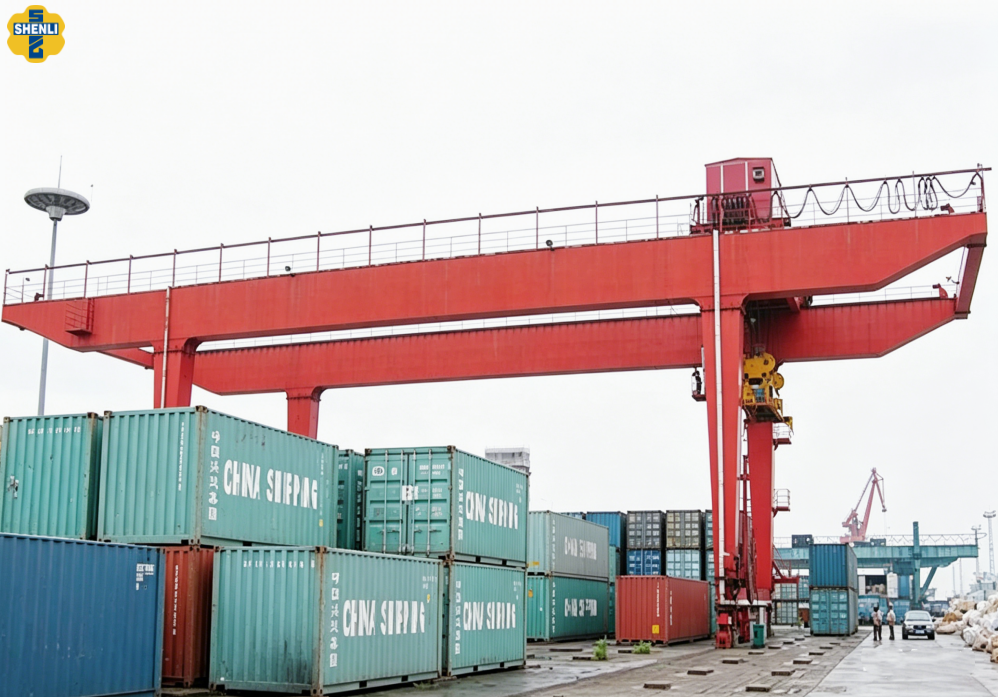
Ports are the most visible home of large gantry cranes. When you see a container terminal, you are looking at dozens of gantry cranes working side by side.
Common gantry crane applications in ports:
-
Container handling – Lifting 20‑foot and 40‑foot containers from ships, stacking them in storage yards, and loading them onto trucks or trains.
-
Bulk cargo handling – Moving coal, grain, ore, or cement from ship to storage.
-
Empty container handling – Stacking empty containers up to 10 high.
Types used in ports:
| Type | Typical Capacity | Best for |
|---|---|---|
| Rail‑mounted gantry crane (RMG) | 30–65 tons | Dense stacking, fixed yard layout, high precision |
| Rubber‑tired gantry crane (RTG) | 20–50 tons | Flexible stacking, moving between yard blocks |
| Ship‑to‑shore (STS) crane | 40–100+ tons | Loading/unloading ships (specialised gantry type) |
A port operator looking for a gantry crane for container handling will usually choose an RMG for permanent storage blocks and an RTG for flexibility. Some large terminals use both.
Why gantry cranes work well in ports:
Long spans (up to 50 meters or more), high lifting capacity, and the ability to work outdoors 24/7. Rail‑mounted versions give precise positioning for container stacking, while rubber‑tired versions allow the yard layout to change over time.
3. Industry 2: Steel Mills & Metal Processing
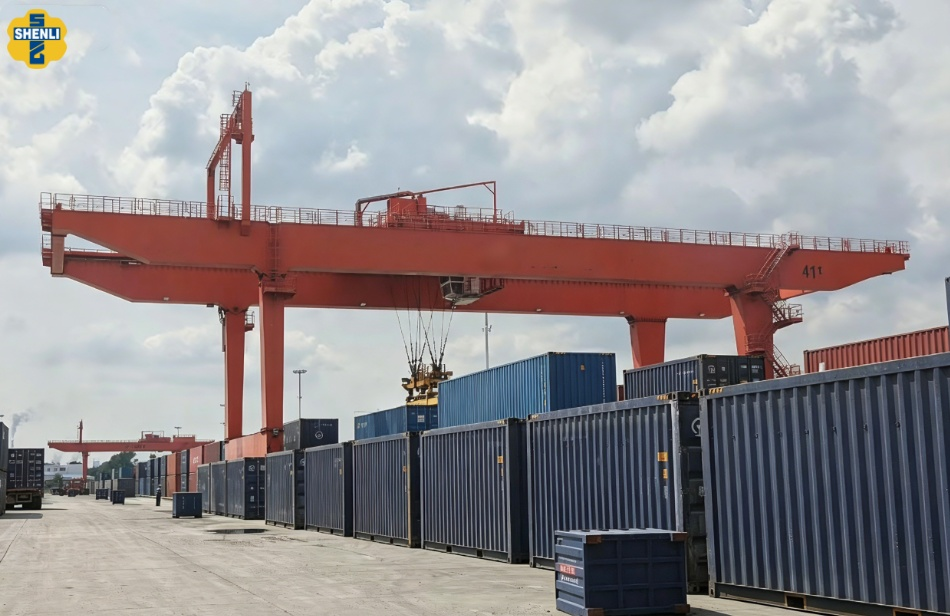
Steel mills are among the toughest environments for any crane. Extreme heat, heavy dust, continuous operation, and loads that can reach 50 tons per lift – this is where gantry cranes prove their durability.
Common gantry crane applications in steel mills:
-
Steel coil handling – Lifting and moving coils that weigh 15–30 tons each.
-
Slab and billet handling – Moving semi‑finished steel products from casting to storage.
-
Scrap handling with electromagnets – Loose scrap is lifted by electromagnetic gantry cranes and dropped into furnaces.
-
Plate and structural steel storage – Stacking steel plates or beams in outdoor yards.
Types used in steel mills:
| Type | Typical Capacity | Best for |
|---|---|---|
| Double girder gantry crane | 10–100+ tons | Heavy loads, continuous duty, high temperature |
| Single girder gantry crane | 5–20 tons | Lighter steel products, intermittent use |
| Electromagnetic gantry crane | 5–50 tons | Scrap and loose ferrous material |
Special requirements for steel mills:
-
Heat‑resistant motors and cables (ambient temperature can exceed 80°C / 176°F near furnaces)
-
Heat shields on the crane structure
-
High duty cycle (CMAA Class D or above, FEM 3m or higher)
-
Dust‑proof electrical enclosures
*If your steel mill runs 24/7 with loads over 20 tons, a standard single girder gantry crane will fail quickly. You need a double girder metallurgical‑grade unit.*
For more details on steel mill crane failures, read our article: [Steel Mill Overhead Crane Failure: Causes & Solutions] .
4. Industry 3: Precast Concrete & Construction Sites
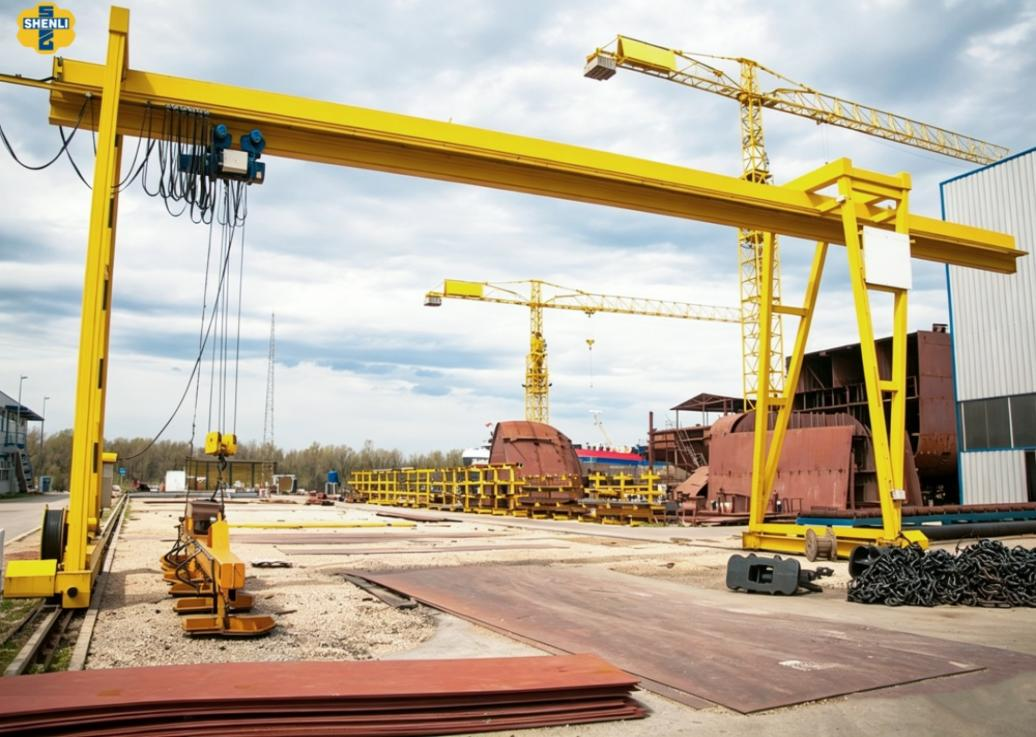
Precast concrete yards and construction sites need gantry cranes that are flexible, sometimes portable, and able to handle heavy, awkward loads.
Common gantry crane applications in precast concrete:
-
Lifting concrete panels – Vertical wall panels can weigh 10–30 tons.
-
Moving concrete beams – Long, heavy beams for bridges or parking structures.
-
Turning and stacking – Rotating concrete pieces for curing or storage.
-
Transporting between work stations – Moving a mould or finished piece from casting bed to storage yard.
Types used in precast and construction:
| Type | Typical Capacity | Best for |
|---|---|---|
| Rubber‑tired gantry crane (RTG) | 10–50 tons | Moving between different casting beds and storage areas |
| Portable / adjustable gantry crane | 1–10 tons | Small construction sites, occasional lifts |
| Rail‑mounted gantry crane | 20–100 tons | Fixed large‑scale precast yards |
On construction sites themselves, you will often see smaller portable gantry cranes used for:
-
Positioning HVAC units on rooftops
-
Lifting generators and pumps into place
-
Installing prefabricated staircases or wall sections
-
Loading building materials onto upper floors
A gantry crane for precast concrete yard is usually rubber‑tired so it can move freely between the casting area, curing racks, and loading bay. Fixed rail‑mounted types work better for high‑volume, permanent yards.
5. Industry 4: Shipbuilding & Offshore
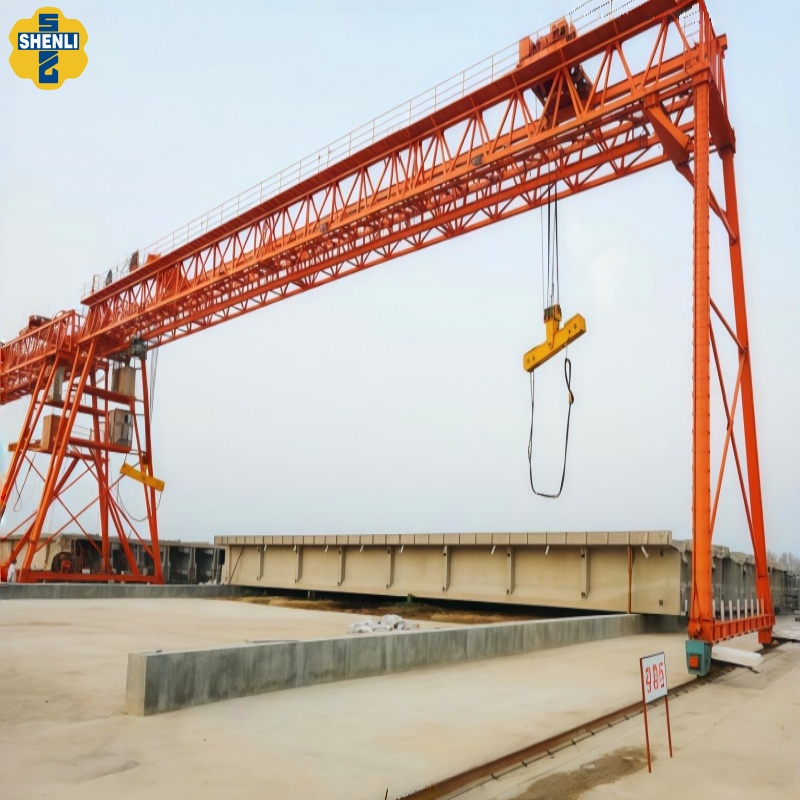
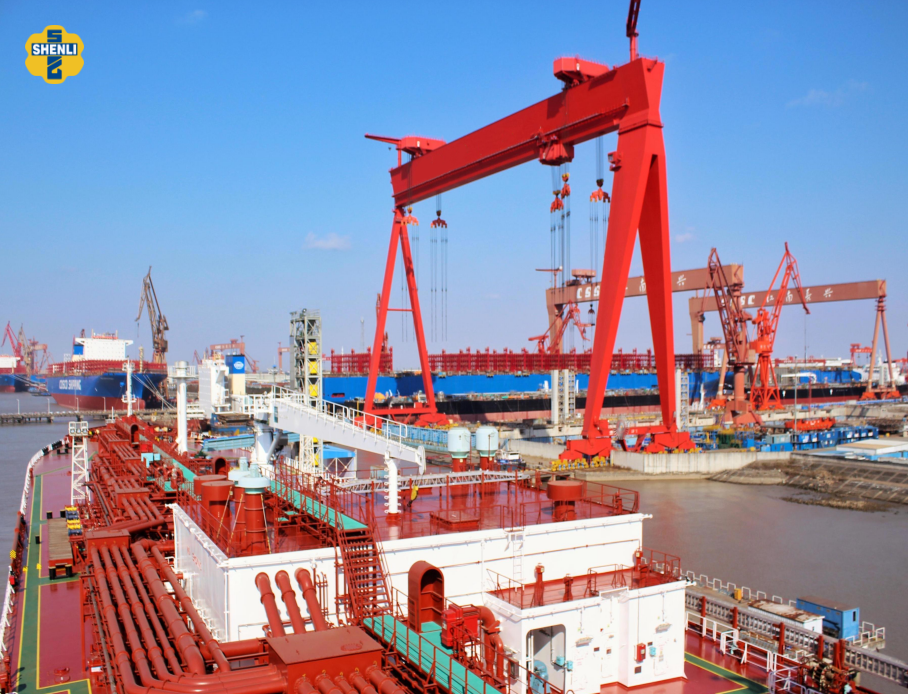
Shipyards need some of the largest gantry cranes ever built. These machines dominate the skyline above dry docks and assembly areas.
Common gantry crane applications in shipbuilding:
-
Moving ship blocks – Lifting entire pre‑assembled sections of a ship (weighing 100–500 tons) and positioning them for welding.
-
Placing engines and machinery – Heavy marine diesel engines, generators, and propellers.
-
Launching and docking – Moving ships in and out of dry docks.
-
Offshore platform assembly – Lifting large modules for oil rigs or wind turbine foundations.
Types used in shipbuilding:
| Type | Typical Capacity | Best for |
|---|---|---|
| Full gantry crane (Goliath crane) | 100–1,000+ tons | Ship block assembly, covering entire dry docks |
| Double girder gantry crane | 20–200 tons | Component handling, smaller shipyards |
| Semi‑gantry crane | 10–100 tons | Where one side is supported by an existing structure |
Why shipyards need such large gantry cranes:
-
Extremely wide spans (50–100+ meters) to cover a dry dock.
-
Very high lifting height (sometimes 80 meters above ground).
-
Dual trolleys allow two lifts at the same time.
-
High precision is required – ship blocks must align within millimeters.
If you search for a gantry crane for shipyard, look for “full gantry” or “Goliath” types.
For more on full gantry vs semi‑gantry designs, see our [types of gantry cranes guide].
6. Industry 5: Warehouses & Small Workshops
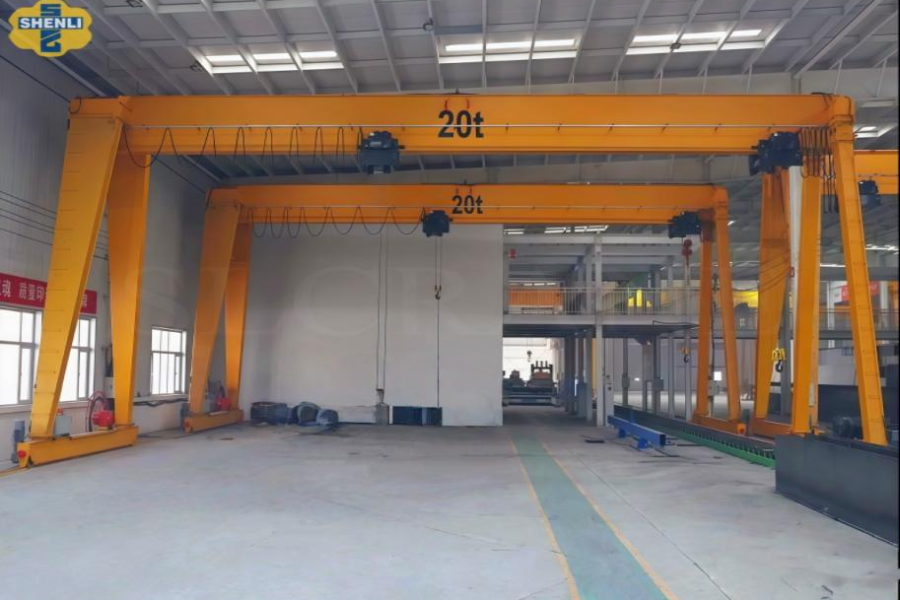
Not every gantry crane is a giant. Small‑ and medium‑sized workshops, warehouses, and garages rely on portable or single girder gantry cranes every day.
Common gantry crane applications in small workshops:
-
Engine removal – Lifting engines out of trucks, tractors, or industrial machinery.
-
Machine repair – Moving heavy motors, pumps, or gearboxes to a repair bench.
-
Die and mould handling – Changing heavy tooling in a press or injection moulding machine.
-
Loading trucks – Lifting pallets, drums, or equipment onto flatbeds.
-
Assembly line support – Positioning components at assembly stations.
Types used in workshops:
| Type | Typical Capacity | Best for |
|---|---|---|
| Portable gantry crane (steel or aluminium) | 0.5–5 tons | Occasional lifts, moving between different bays |
| Adjustable gantry crane (telescoping legs) | 1–10 tons | Varying load heights, rental or shared use |
| Fixed single girder gantry crane | 2–20 tons | Dedicated work cell with permanent location |
What workshop owners look for:
-
Low cost and simple operation
-
Small footprint when not in use (portable units can be disassembled)
-
Adjustable height and span to fit different jobs
-
Ease of movement (casters or wheels)
A gantry crane for small workshop is almost always a portable or adjustable unit. It is the most cost‑effective way to add lifting capacity without modifying the building.
For small workshops, we also offer a range of [portable gantry cranes].
7. Industry 6: Wind Energy & Power Plants
The renewable energy sector, especially wind, has created new gantry crane applications in recent years. Power plants – both traditional and renewable – need heavy lifting for installation and maintenance.
Common gantry crane applications in wind energy:
-
Turbine assembly – Lifting nacelles (the top part containing the generator) and blades into position.
-
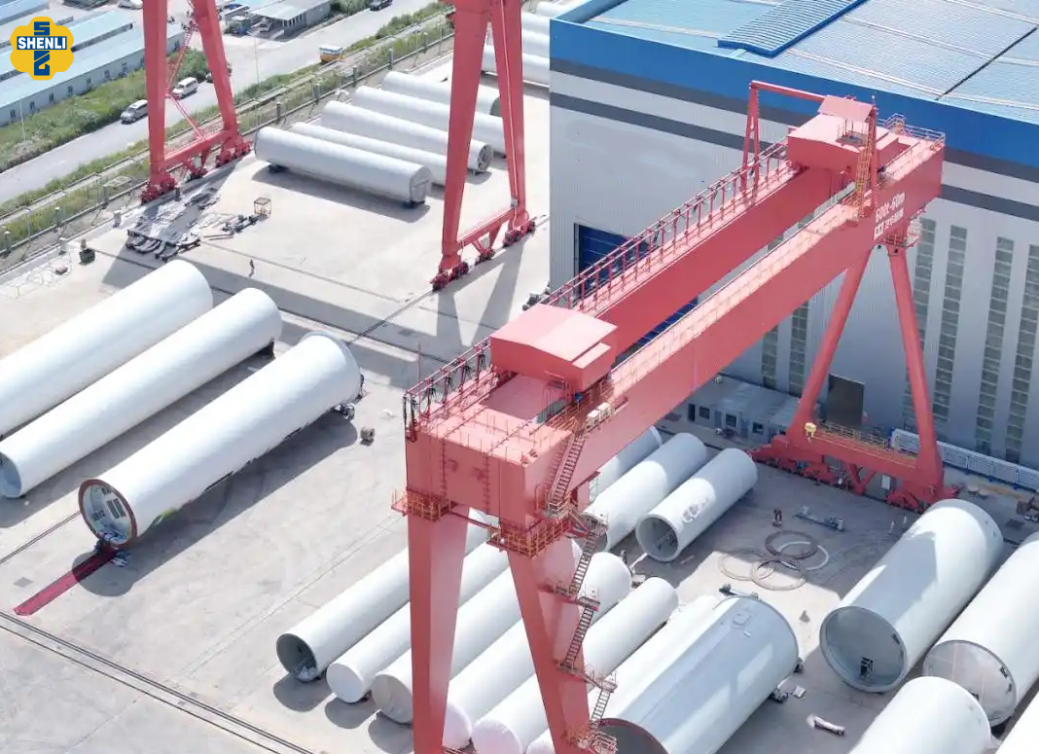
Tower section handling – Moving and aligning steel tower sections before bolting.
-
Maintenance lifts – Replacing gearboxes, generators, or blades on existing turbines.
Common applications in power plants (coal, gas, nuclear, hydro):
-
Turbine and generator maintenance – Lifting heavy rotors, stators, and casing covers.
-
Transformer handling – Moving large power transformers (30–100 tons) for repair or replacement.
-
Valve and pump overhaul – Accessing large valves and pumps in power generation buildings.
Types used in energy:
| Type | Typical Capacity | Best for |
|---|---|---|
| Double girder gantry crane | 20–200 tons | Heavy lifts, wind turbine assembly, power plant maintenance |
| Portable gantry crane | 1–20 tons | Smaller maintenance tasks (pumps, small transformers) |
| Rail‑mounted gantry crane | 30–150 tons | Fixed outdoor yards (e.g., transformer storage) |
Special requirements for energy applications:
-
High precision (for aligning turbine components)
-
Corrosion protection (coastal wind farms or outdoor power yards)
-
Remote control (for operator safety during large lifts)
-
Sometimes explosion‑proof components (for gas power plants)
A gantry crane for wind turbine assembly is typically a custom‑engineered double girder unit with anti‑sway and high‑precision positioning.
8. Industry 7: Rail Yards & Maintenance Depots
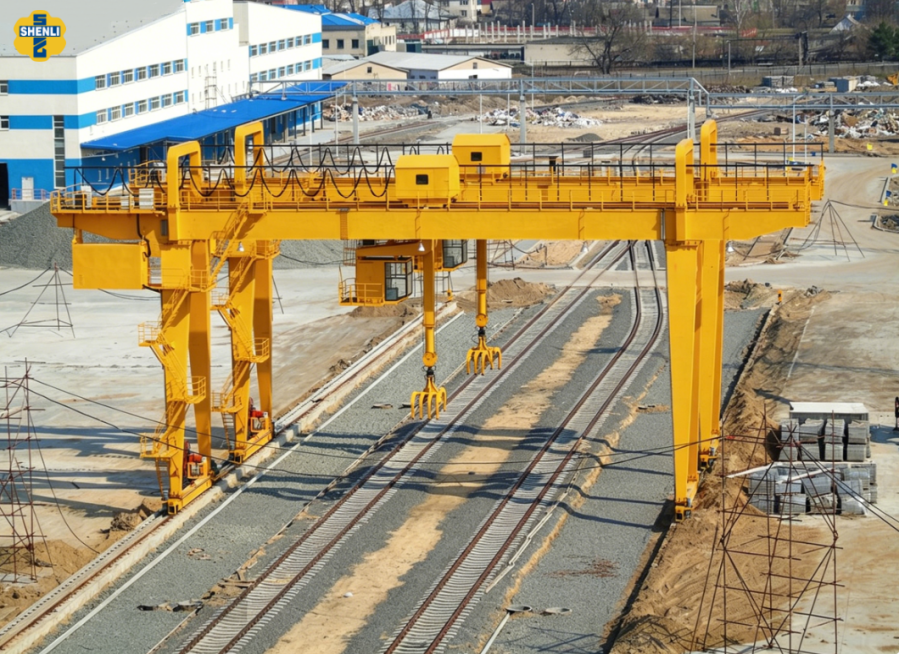
Rail freight yards and locomotive maintenance facilities use gantry cranes for two main purposes: moving bulk materials and lifting heavy railway components.
Common gantry crane applications in rail yards:
-
Bulk material handling – Lifting coal, ore, ballast, or scrap from railcars to stockpiles.
-
Intermodal container handling – Lifting containers from railcars to trucks or storage.
-
Railcar repair – Removing wheelsets, couplers, or entire truck assemblies.
Types used in rail yards:
| Type | Typical Capacity | Best for |
|---|---|---|
| Rail‑mounted gantry crane (RMG) | 10–50 tons | Fixed rail yards, high‑volume bulk handling |
| Portable gantry crane | 2–20 tons | Maintenance depots, occasional railcar repairs |
| Double girder gantry crane | 20–100 tons | Heavy component handling (locomotive engines, transformers) |
What makes rail yard applications unique:
-
The crane often spans multiple rail tracks (wide span required)
-
Precise positioning is not as critical as in container yards, but reliability is essential
-
Outdoor operation with dust and weather exposure
For a gantry crane for rail yard, rail‑mounted types are the most common because they can travel the full length of the yard on fixed tracks. Portable units work well in maintenance pits.
9. How to Choose a Gantry Crane for Your Application (Quick Checklist)
After reading through the seven industries, you probably have a good idea of where your operation fits. But how do you narrow down to the exact type?
Answer these five questions:
1. What is your maximum load weight?
-
Under 5 t → Portable or single girder
-
5–20 t → Single girder (or double girder if high frequency)
-
Over 20 t → Double girder
2. Where will the crane operate?
-
Indoor only → Most types work
-
Outdoor → Wind brakes + corrosion protection required; double girder preferred for stability
3. How often will you use it?
-
Occasional (few lifts/day) → Portable or single girder
-
Regular (several hours/day) → Single or double girder
-
Continuous (8+ hours/day) → Double girder with high duty class (CMAA Class D+)
4. Do you need the crane to move?
-
No movement → Fixed gantry crane
-
Move on a fixed path → Rail‑mounted gantry crane (RMG)
-
Move freely around a yard → Rubber‑tired gantry crane (RTG)
-
Move around a workshop → Portable gantry crane
5. Any special environment conditions?
-
High temperature (steel mill) → Heat‑resistant motors + cables + heat shields
-
Dusty or corrosive → Sealed electrics + special coatings
-
High wind area → add wind brakes and anemometer
-
High lifting height requirement → Double girder
Quick reference table:
| Your application | Recommended gantry crane type |
|---|---|
| Container terminal (dense stacking) | Rail‑mounted gantry crane (RMG) |
| Container terminal (flexible layout) | Rubber‑tired gantry crane (RTG) |
| Steel mill (heavy, continuous) | Double girder gantry crane (metallurgical grade) |
| Precast concrete yard | Rubber‑tired or rail‑mounted (depending on volume) |
| Small workshop / garage | Portable or adjustable gantry crane |
| Wind turbine assembly | Double girder with anti‑sway and precision control |
| Shipyard (large blocks) | Full gantry crane (Goliath) |
| Rail yard (bulk handling) | Rail‑mounted gantry crane |
This checklist is a starting point. For a detailed selection guide, see our [how to choose a gantry crane] .
Our Crane Product Range
SLKJcrane provides a wide range of lifting equipment solutions including:
– Single Girder Overhead Crane
– Double Girder Overhead Crane
– Gantry Crane
– Spider Crane
– Marine Crane
Our engineering team can configure safety devices and technical solutions according to project requirements.
10. Need a Gantry Crane for Your Industry?
You have seen how gantry cranes are used in ports, steel mills, precast yards, shipyards, workshops, wind farms, and rail depots. Now it is time to find the right one for your operation.
At SLKJCrane, we design and manufacture gantry cranes for all these applications – and more. Whether you need a small portable unit for your garage or a 200‑ton rail‑mounted giant for a container terminal, we can help.
We provide:
-
Free application consulting – tell us your industry and load requirements
-
Custom‑engineered gantry cranes (single girder, double girder, RMG, RTG, portable, semi‑gantry, full gantry)
-
Full documentation: CAD drawings, load charts, FEM/ISO compliance certificates
-
Worldwide shipping and remote installation guidance
📞 Contact us today – Tell us your industry, load weight, span, and working environment. We will recommend the right gantry crane for your budget and timeline.

Expert in Overhead Crane/Gantry Crane/Jib Crane/Crane Parts Solutions
Eileen
With 20+ years of experience in the Crane Overseas Export Industry, helped 10,000+ customers with their pre-sales questions and concerns, if you have any related needs, please feel free to contact me!
FAQ
Container handling at ports is probably the most visible. But by number of units, small workshops using portable gantry cranes are extremely common.
Yes. A rubber‑tired gantry crane (RTG) can handle containers, steel coils, and precast concrete – as long as the capacity and span match. Portable units are also used in many different workshops.
Double girder rail‑mounted or rubber‑tired types. Both can be built with corrosion protection and wind brakes. Single girder can also work outdoors for lighter loads, but double girder is more stable in wind.
A well‑maintained double girder gantry crane in a steel mill or port can last 20–30 years. Portable units in workshops may last 10–15 years depending on usage.
Rail‑mounted types need a reinforced concrete foundation. Rubber‑tired and portable types need level, solid ground but not a poured foundation.
No. Gantry cranes are designed for material handling, not personnel lifting. Using them to lift people is dangerous and against safety regulations (OSHA, etc.). Use a man lift or aerial work platform instead.
Estimate your average daily operating hours and load intensity. Intermittent use → CMAA Class C or D. Continuous 24/7 heavy use → CMAA Class F or FEM 5m. Ask your manufacturer for help.
Yes, but they are specialised. Low‑height, explosion‑proof, and often rail‑mounted types are used in maintenance bays underground. Standard gantry cranes are more common on the surface.
Latest Blog
Lorem ipsum dolor sit amet, consectetur adipiscing elit, sed do eiusmod tempor incididunt ut labore et dolore magna aliqua
Gantry Crane Price Guide 2026
Gantry Crane Price Guide 2026: Cost by Tonnage, Type & Configuration Table of Contents Why a Gantry Crane
Hidden Costs of Importing a Gantry Crane
Hidden Costs of Importing a Gantry Crane: Shipping, Customs and Installation Guide Why Is a Gantry Crane Quote
Used vs New Gantry Crane: Total Cost of Ownership Explained
Used vs New Gantry Crane: Which One Has Lower Total Cost of Ownership (TCO)? Introduction When purchasing a
Gantry Crane Predictive Maintenance: How IoT Sensors Reduce Downtime
Gantry Crane Predictive Maintenance: How IoT Sensors Reduce Downtime Why Does Gantry Crane Downtime Cost So Much? Gantry
Contact Us Now
Have questions about our cranes or need help?
Reach out to our friendly team for expert support and guidance.
We are here to help you power your journey towards a greener future !
Address: Crane Industry Park, Xinxiang City Henan Provice
Hot Sales
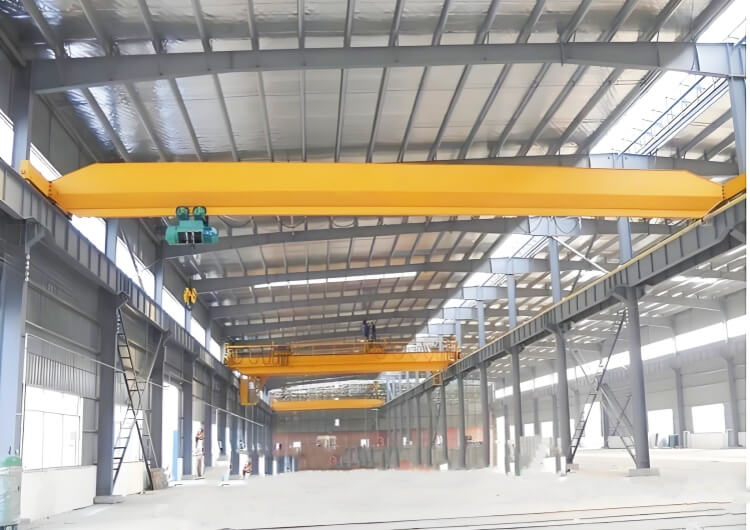
Single girder overhead cranes
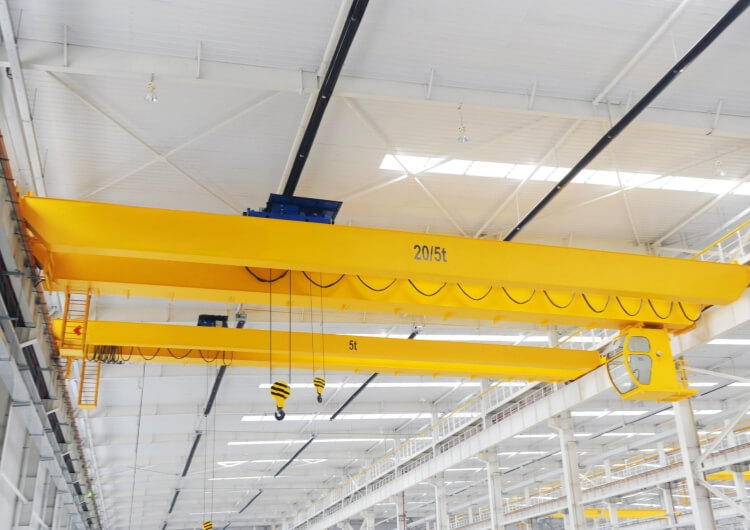
Double girder overhead cranes
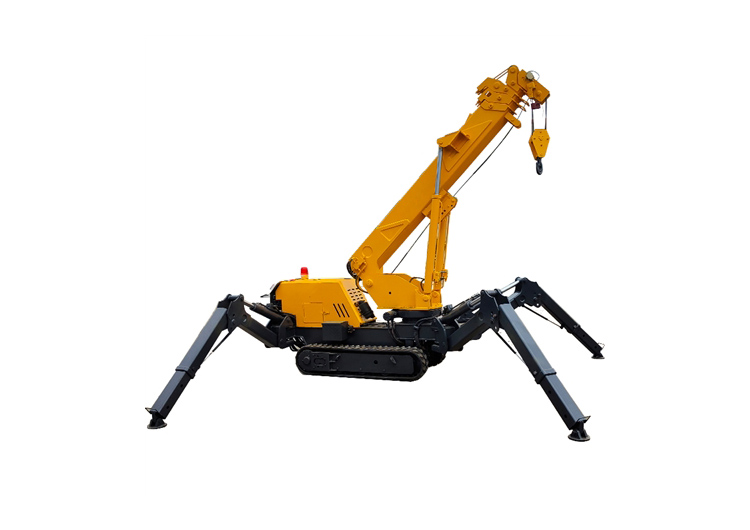
Spider cranes