
Types of Gantry Cranes – The Complete Guide
Table of Contents
-
Three Ways to Classify Gantry Cranes
-
Classification by Structural Design
-
Classification by Mobility
-
Classification by Industry / Application
-
Key Components of a Gantry Crane
-
Gantry Crane Safety Standards (OSHA, ASME, FEM, ISO)
-
How to Choose the Right Gantry Crane: A Step‑by‑Step Guide
-
Frequently Asked Questions (FAQ)
Introduction
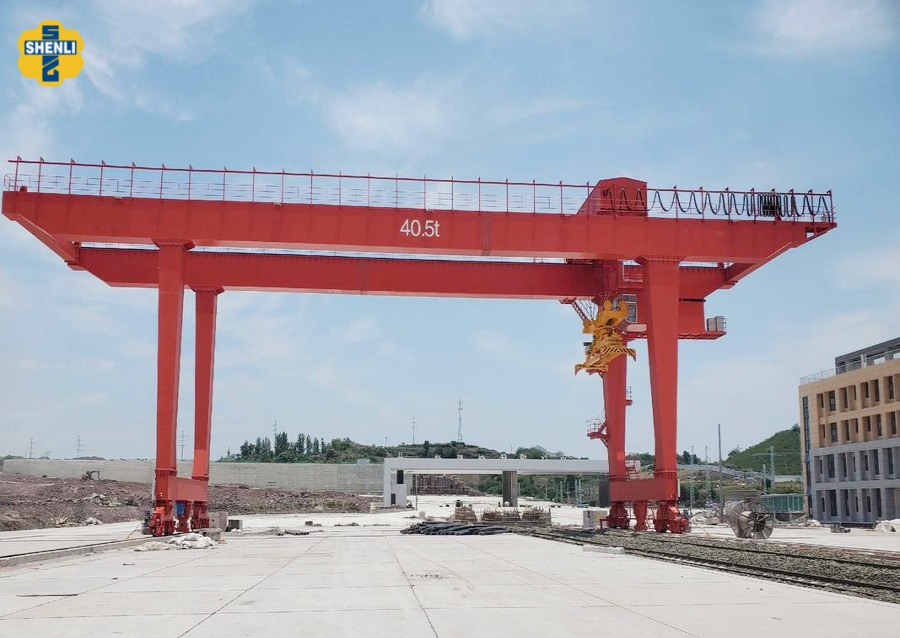
Gantry cranes are among the most widely used lifting equipment in industrial material handling. You see them everywhere – unloading containers at ports, moving heavy steel coils in steel mills, repairing machinery in small workshops, and assembling giant vessels in shipyards.
What makes them special is that they are self‑supporting (with their own legs) and stand on the ground, independent of building structures. That is why they work both indoors and outdoors.
However, gantry cranes vary significantly in structure, mobility, and application. This guide gives you a clear overview of the main types, key components, and selection methods – helping you find the right solution quickly.
1. Three Ways to Classify Gantry Cranes
Gantry cranes are usually classified along three dimensions:
| Classification Dimension | Main Types | What Matters Most |
|---|---|---|
| By structural design | Single girder, double girder, full gantry, semi‑gantry | Lifting capacity, stability, cost |
| By mobility | Rail‑mounted (RMG), rubber‑tired (RTG), portable, fixed | Need for travel and site conditions |
| By industry / application | Port container handling, steel mill (metallurgical), construction / precast, small repair shops | Real‑world working environment |
2. Classification by Structural Design
Structural design determines lifting capacity, stability, and price – this is usually the starting point for industrial buyers.
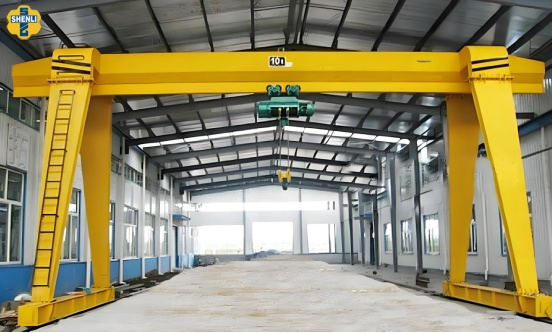
2.1 Single Girder Gantry Crane
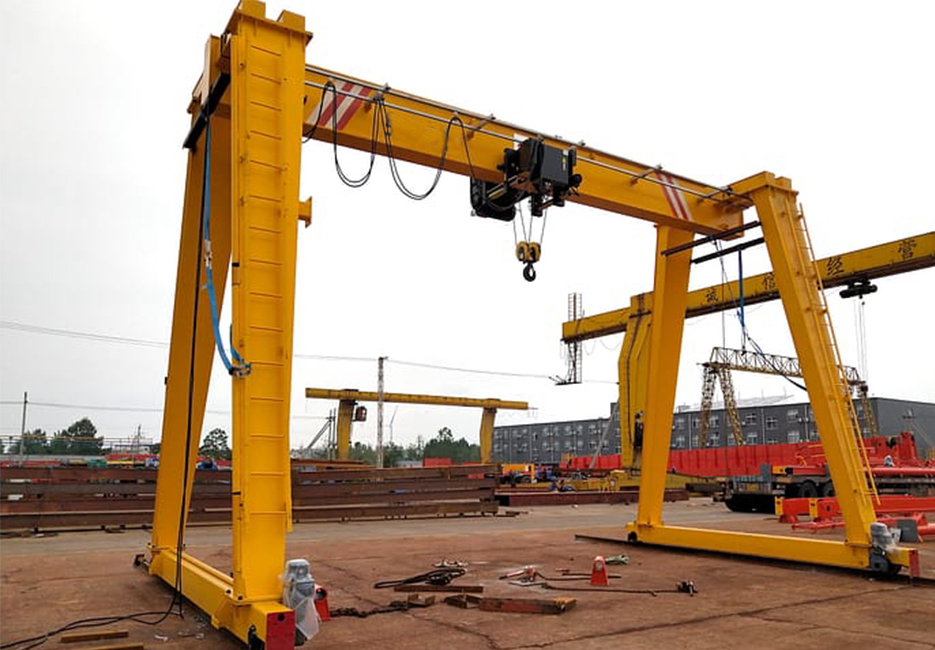
Uses a single main girder; the hoist runs under the girder.
Typical specifications: Capacity up to 32 tons (most common 5–20 tons), span up to 30 meters, electric wire rope hoist or chain hoist.
Advantages: Low initial cost (30–50% less than a comparable double girder), light dead weight, low ground load, simple maintenance and operation, easy installation (no heavy foundation needed).
Limitations: Limited lifting height; lower rigidity – more sway with heavy loads; not suitable for continuous high‑frequency operation.
Best for: Small to medium workshops, warehouses, light assembly lines, fabrication shops.
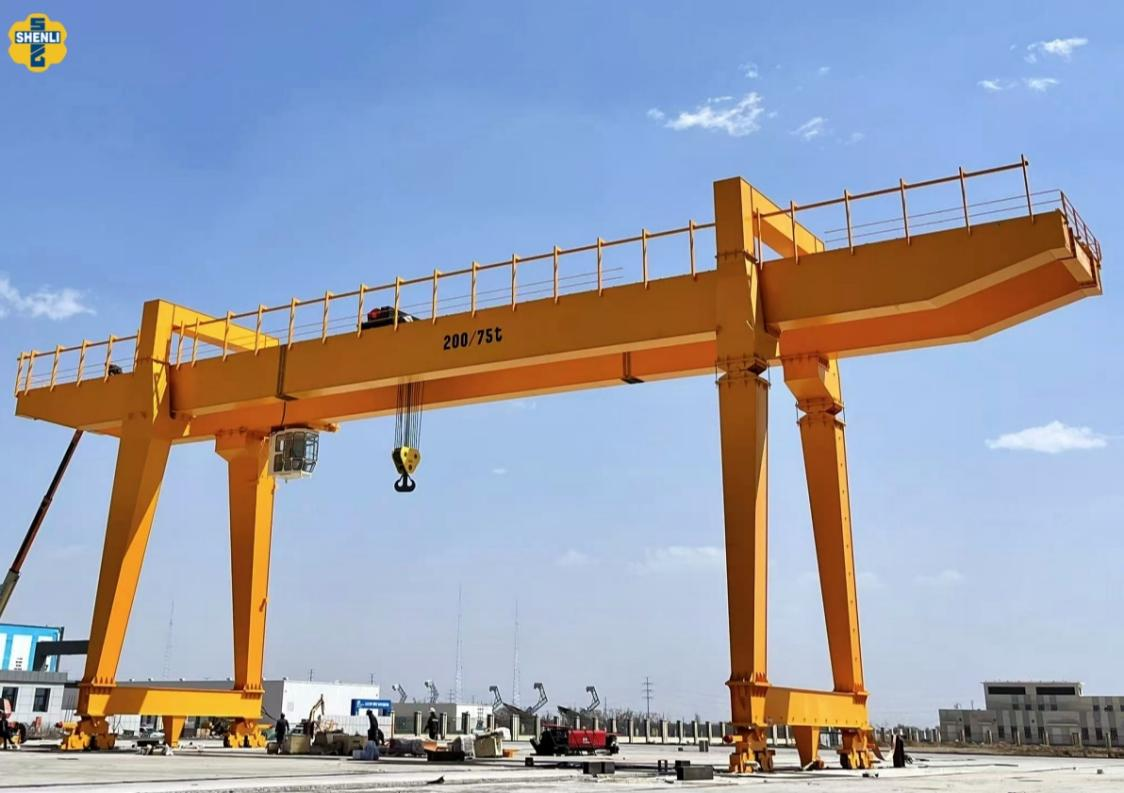
2.2 Double Girder Gantry Crane

Uses two parallel main girders; the trolley runs on rails on top of the girders.
Typical specifications: Capacity 5–500+ tons, span 10–50+ meters, trolley‑mounted electric wire rope hoist (supports dual hoist options).
Advantages: Higher lifting capacity; greater lifting height for the same overall crane height; excellent stability and wind resistance; suitable for 24/7 continuous operation; can accommodate dual hoists, anti‑sway systems, and other advanced features.
Limitations: Higher initial cost; heavier dead weight requiring stronger foundations; more complex maintenance.
Best for: Steel mills, shipyards, ports, heavy manufacturing plants – any application where loads exceed 20 tons or operation is continuous.
2.3 Full Gantry Crane
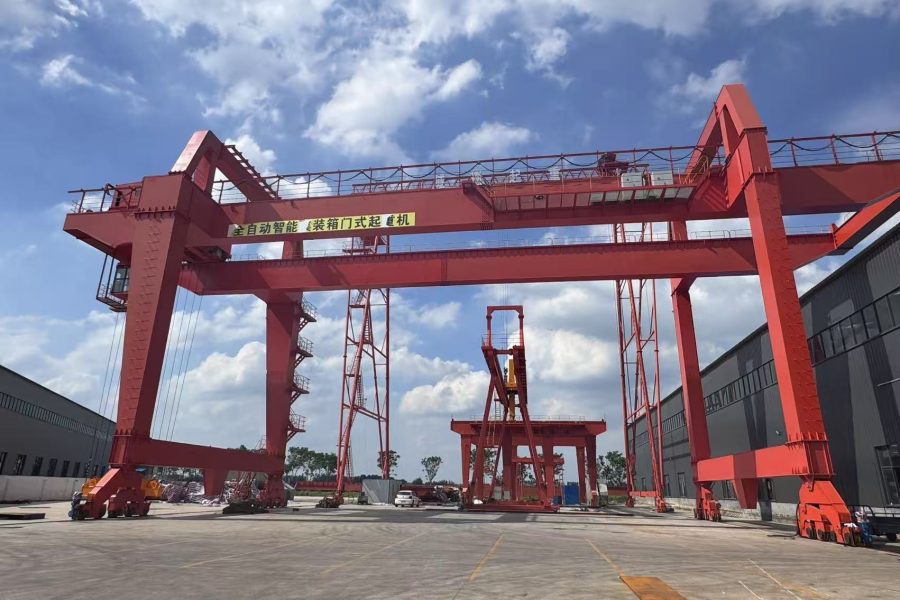
Two rigid legs running on ground rails; the bridge spans the entire workspace between the legs. Offers the highest stability.
Typical specifications: Capacity 5–500+ tons, span 10–50+ meters, both legs rigid on fixed rails.
Advantages: Maximum stability, ideal for long spans and heavy loads, high positioning accuracy.
Limitations: Requires permanent rails; less flexible than semi‑gantry or rubber‑tired types; higher infrastructure cost.
Best for: Port terminals, shipyards, large outdoor storage yards, steel fabrication bases – any application that needs heavy lifting over a wide area.
2.4 Semi Gantry Crane
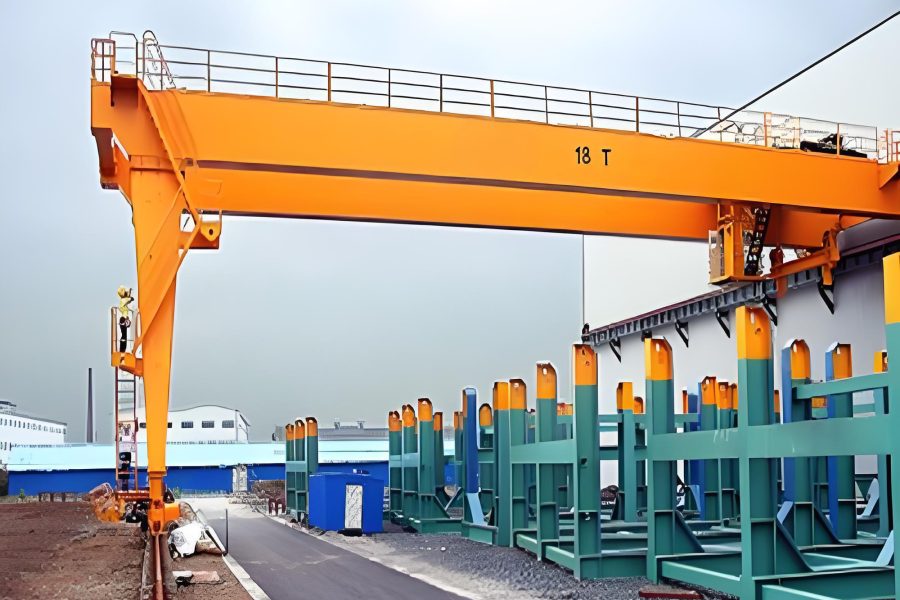
One leg runs on a ground rail; the other side is supported by an existing building structure (wall‑mounted runway beam or column).
Typical specifications: Capacity 3–50 tons, span usually shorter than that of a full gantry crane.
Advantages: Saves floor space on one side; lower cost than a full gantry; utilises existing building support.
Limitations: Requires adequate building strength; not suitable for very wide spans; less flexible for future relocation.
Best for: Factories that load/unload along exterior walls, facilities with existing support columns, areas where floor space is limited.
3. Classification by Mobility
Not every worksite has permanent rails, so how a crane moves is another important classification.
3.1 Rail Mounted Gantry Crane (RMG)
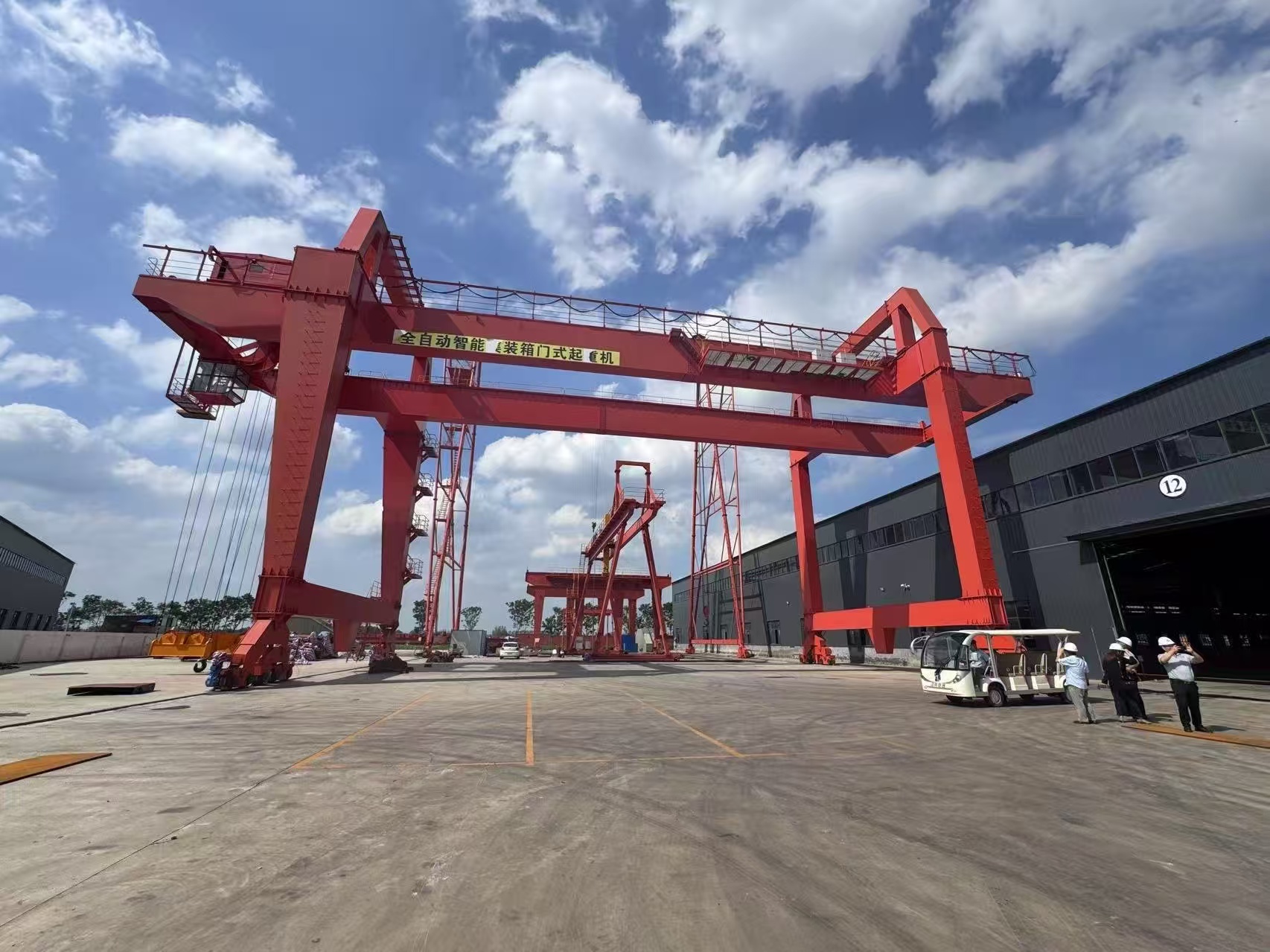
RMG cranes run on embedded steel rails. They are designed for fixed‑path, high‑precision handling.
Typical specifications: Capacity 20–100+ tons, span 20–50+ meters, powered by cable reel or busbar.
Advantages: Excellent stability; high positioning accuracy; easy to automate; suitable for long spans and heavy loads.
Limitations: High infrastructure investment; fixed travel path.
Best for: Container terminals, rail freight yards, shipyards – any operation that needs precise, repeatable movement along a fixed path.
3.2 Rubber Tired Gantry Crane (RTG)
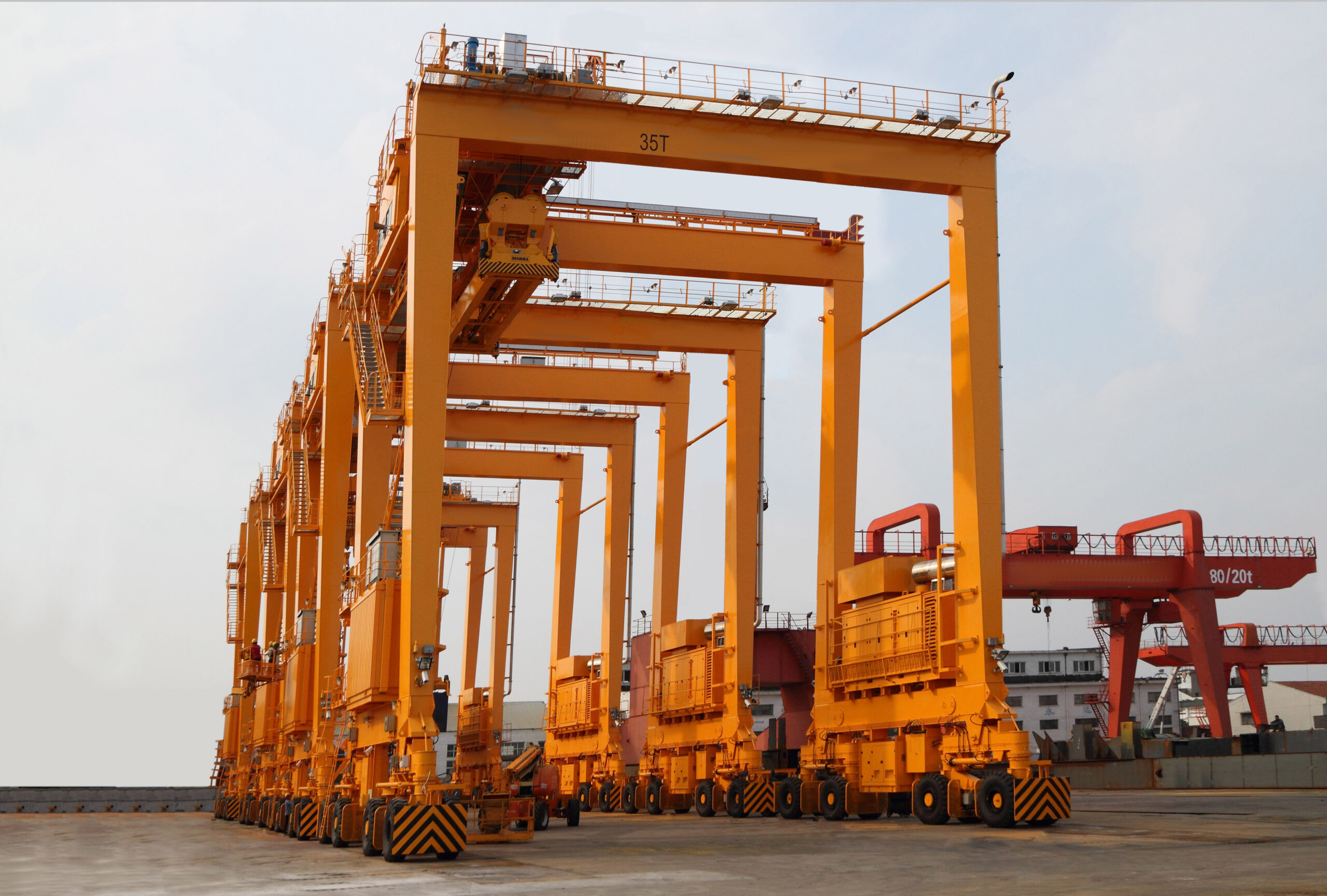
RTG cranes run on large rubber tires and are self‑propelled, with excellent steering and turning capability.
Typical specifications: Capacity 20–100+ tons, stacking height up to 6–7 containers, powered by diesel (traditional) or electricity (modern).
Advantages: Outstanding mobility; no fixed rails required; flexible yard layout.
Limitations: Traditional diesel models produce noise and emissions; higher operating cost than rail‑mounted; lower positioning accuracy than RMG.
Best for: Container yards, steel stockyards, precast concrete facilities – outdoor storage areas where permanent rails are not practical.
RMG vs RTG: Choose RMG if you need maximum stacking density and precision on a permanent yard. Choose RTG if your yard layout changes often or you need to move between areas.
3.3 Portable / Adjustable Gantry Crane
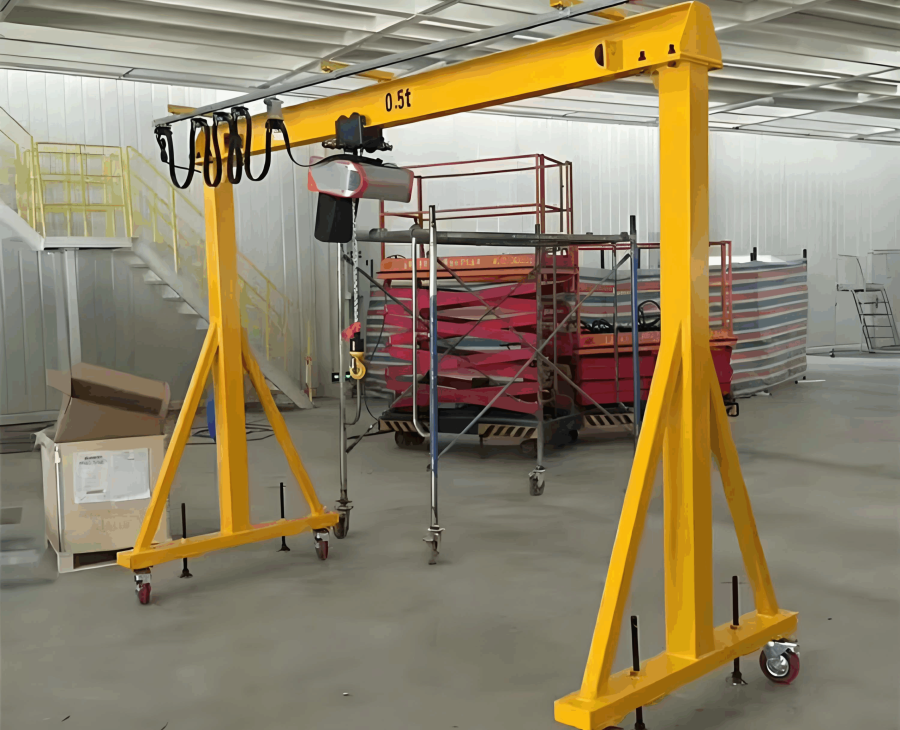
Lightweight units that can be pushed by hand, disassembled, or folded for storage.
Typical specifications: Capacity 0.5–5 tons (max commonly 10 tons), span 2–8 m, height usually adjustable (telescoping legs), steel or aluminium construction (aluminium for maximum portability).
Advantages: Highly portable; low cost; quick assembly/disassembly; most models have adjustable height and span.
Limitations: Limited capacity (generally under 10 tons); lower stability than fixed cranes; often manually operated; not for high‑frequency use.
Best for: Maintenance workshops, garages, small fabrication shops, equipment installation sites – the entry‑level choice for small workshops.
4. Classification by Industry / Application
A gantry crane uses three coordinated movements to lift and precisely position a load.
4.1 Container Handling (Ports & Terminals)
Large gantry cranes are used in combination:
Ship‑to‑shore (STS) cranes for vessel loading/unloading (typical capacity 30–65 tons).
Rail‑mounted gantry cranes (RMG) for dense yard stacking.
Rubber‑tired gantry cranes (RTG) for flexible inter‑block transfer (typical capacity 20–50 tons).
4.2 Steel Mills & Metal Processing
Harsh conditions – high temperature, dust, heavy loads, continuous operation.
Double girder gantry cranes are the standard (typical capacity 20–50 tons). Heat‑resistant motors, heat shields, and special attachments (magnets, coil lifters) are often required.
4.3 Shipbuilding & Offshore
Covers dry docks and large assembly areas. Full gantry cranes with spans of 50–100+ meters and capacities of 100–500+ tons are typical. Often equipped with dual trolleys and special lifting beams. Stability and positioning accuracy are critical.
4.4 Construction & Precast Concrete
Flexibility is key. Precast yards often use RTGs to move concrete panels and beams. Construction sites commonly use portable gantry cranes for lifting equipment and materials. Capacities typically range from 5 to 50+ tons.
4.5 Rail Freight Yards & Maintenance Depots
Rail‑mounted gantry cranes handle bulk materials (coal, ore, aggregates) from railcars. Portable gantry cranes are used for lifting locomotive components. Typical capacity 10–50 tons.
4.6 Small Workshops & Maintenance
Portable and adjustable gantry cranes are the mainstay. Capacities 0.5–5 tons, used for engine removal, machine repair, equipment positioning – low cost, high adaptability.
4.7 Wind Energy & Power Plants
Used for lifting wind turbine blades, nacelles, tower sections, and heavy power plant equipment. Often require high positioning accuracy, corrosion protection, and sometimes explosion‑proof features.
5. Key Components of a Gantry Crane
Understanding the main components helps with selection, maintenance, and troubleshooting.
-
Legs (gantry structure): Vertical supports that transfer the weight to wheels, tracks, or tires. Can be rigid or hinged.
-
Bridge girder: The main horizontal beam (single or double). On a single girder, the hoist runs underneath; on a double girder, the trolley runs on top. Must have enough stiffness.
-
End trucks: Mounted at the base of each leg. Contain wheels, axles, and drives. Rail‑mounted types have flanged wheels; rubber‑tired types use steering axles and tires.
-
Trolley: Moves along the bridge girder, carrying the hoist. On double girders it runs on top; on single girders it is often integrated with the hoist.
-
Hoist: The lifting mechanism. Most use electric wire rope hoists; smaller portable units may use chain hoists. Includes motor, drum, wire rope, and hook block.
-
Control system: Operator interface – pendant (wired/wireless), remote control, or cabin. Modern systems use PLC controls and variable frequency drives.
-
Power supply: Cable reel, busbar (for rail‑mounted), battery, or diesel engine (for mobile / rubber‑tired).
-
Safety devices: Overload limiter, emergency stop, limit switches, wind brakes (outdoor), anti‑collision systems.
-
Crane runway (rail‑mounted types): Steel rails and foundation. Must be level and properly aligned to avoid binding and uneven wear.
6. Gantry Crane Safety Standards (OSHA, ASME, FEM, ISO)
Compliance with recognised safety standards is essential – both for legal reasons and for safe operation. Common standards include:
-
ASME B30.2 (USA): Core standard for overhead and gantry cranes, covering design, manufacturing, installation, operation, inspection, and maintenance.
-
OSHA 29 CFR 1910.179 (USA): Legally enforceable regulations covering clearances, brakes, inspection frequency, operator training, etc. Requires frequent inspections (daily to monthly) and periodic inspections (monthly to yearly).
-
FEM (Europe): European Material Handling Federation standard. Classifies cranes by duty cycle (FEM 1Am to 5m). Widely used outside North America.
-
CMAA (USA): Crane Manufacturers Association of America specifications, including service classes (A through F). Not a legal requirement but followed by most US manufacturers.
-
ISO 4301‑5:2025 (International): 2025 international standard that classifies bridge and gantry cranes based on number of working cycles and load spectrum.
Selection note: For use in the USA, ensure ASME B30.2 and OSHA compliance. For export to Europe, look for FEM or ISO compliance. Ask your manufacturer if you are unsure.
7. How to Choose the Right Gantry Crane: A Step by Step Guide
Selecting a gantry crane does not need to be complicated. Work through these 8 steps.
Step 1 – Determine the maximum load
Base on your heaviest regular load, then add a 10–25% safety margin.
-
Below 5 tons → Portable or single girder
-
5–20 tons → Single girder (or double girder if high frequency)
-
Above 20 tons → Double girder
Step 2 – Operating environment
-
Indoor only → Single girder for light loads, double girder for heavy loads
-
Outdoor → Double girder preferred, add wind brakes and corrosion protection
Step 3 – Span
Based on the width of your work area.
-
Under 10 m → Most types work
-
10–30 m → Standard gantry cranes
-
Over 30 m → Double girder or truss gantry crane
Step 4 – Frequency of use (duty cycle)
-
Occasional → Portable or single girder
-
Regular (several hours/day) → Single or double girder
-
Continuous (8+ hours/day) → Double girder with high duty class
Under‑specifying for frequency will dramatically shorten equipment life.
Step 5 – Does the crane need to travel?
-
Fixed station → Fixed gantry crane
-
Travel on a fixed path → RMG
-
Flexible travel around a yard → RTG
-
Move around a workshop → Portable gantry crane
Step 6 – Power supply
-
Three‑phase available → Electric (cable reel / busbar)
-
No fixed power → Diesel or battery drive
Step 7 – Special requirements
-
High lifting height → Double girder
-
High temperature → Heat‑resistant configuration
-
Corrosive environment → Special coatings
-
High positioning accuracy → Anti‑sway + VFD
-
Multiple loads at once → Dual trolley / dual hoist
Step 8 – Total budget
Do not look only at the purchase price. Consider: equipment cost + installation + maintenance + energy + service life
Quick selection reference:
| If you need… | Recommended type |
|---|---|
| Light loads, flexible movement | Portable gantry crane |
| Medium loads, limited budget | Single girder gantry crane |
| Heavy loads, continuous operation | Double girder gantry crane |
| Fixed path, high precision | RMG (rail‑mounted) |
| Flexible movement across yard areas | RTG (rubber‑tired) |
| Space‑saving against a wall | Semi‑gantry crane |
| Very long span | Double girder / truss gantry crane |
Our Crane Product Range
SLKJcrane provides a wide range of lifting equipment solutions including:
– Single Girder Overhead Crane
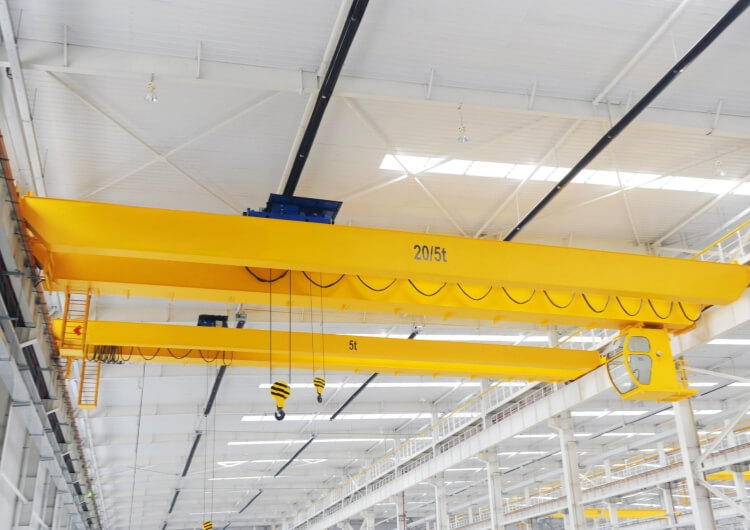
– Double Girder Overhead Crane
– Gantry Crane
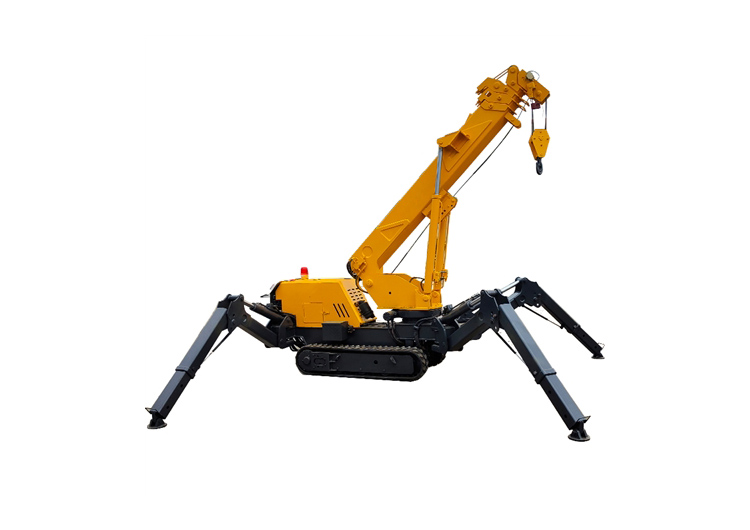
– Spider Crane
– Marine Crane
Our engineering team can configure safety devices and technical solutions according to project requirements.
Need a Gantry Crane Built for Your Application?
If you are still unsure which type of gantry crane suits you best, or if you would like a quotation, please contact the technical team at SLKJCrane.
We have many years of experience manufacturing gantry cranes and provide professional solutions for ports, steel mills, construction sites, warehouses, and manufacturing plants.
We provide:
-
Free selection consulting based on your actual working conditions
-
Custom‑engineered gantry cranes (single girder, double girder, semi‑gantry, rail‑mounted, portable, and more)
-
Full technical documentation (CAD drawings, load charts, compliance certificates)
-
Shipping support and on‑site installation guidance
👉 Contact us and tell us your lifting capacity, span, lifting height, and working environment. We will recommend the right solution for your budget and timeline.

Expert in Overhead Crane/Gantry Crane/Jib Crane/Crane Parts Solutions
Eileen
With 20+ years of experience in the Crane Overseas Export Industry, helped 10,000+ customers with their pre-sales questions and concerns, if you have any related needs, please feel free to contact me!
FAQ
Yes. RMGs are already widely automated in container terminals. RTGs and even smaller gantry cranes can also be fitted with automation features.
It depends. Rail‑mounted types need a level, stable load‑bearing foundation. Rubber‑tired and portable types need a flat, solid ground surface. Heavy rail‑mounted cranes require professional foundation engineering.
At least an overload limiter, emergency stop, limit switches, and audible/visual alarms. Outdoor cranes also need wind brakes and an anemometer.
Yes. Common customisations include span, lifting height, control type, corrosion coating, and specialised lifting attachments.
Latest Blog
Lorem ipsum dolor sit amet, consectetur adipiscing elit, sed do eiusmod tempor incididunt ut labore et dolore magna aliqua
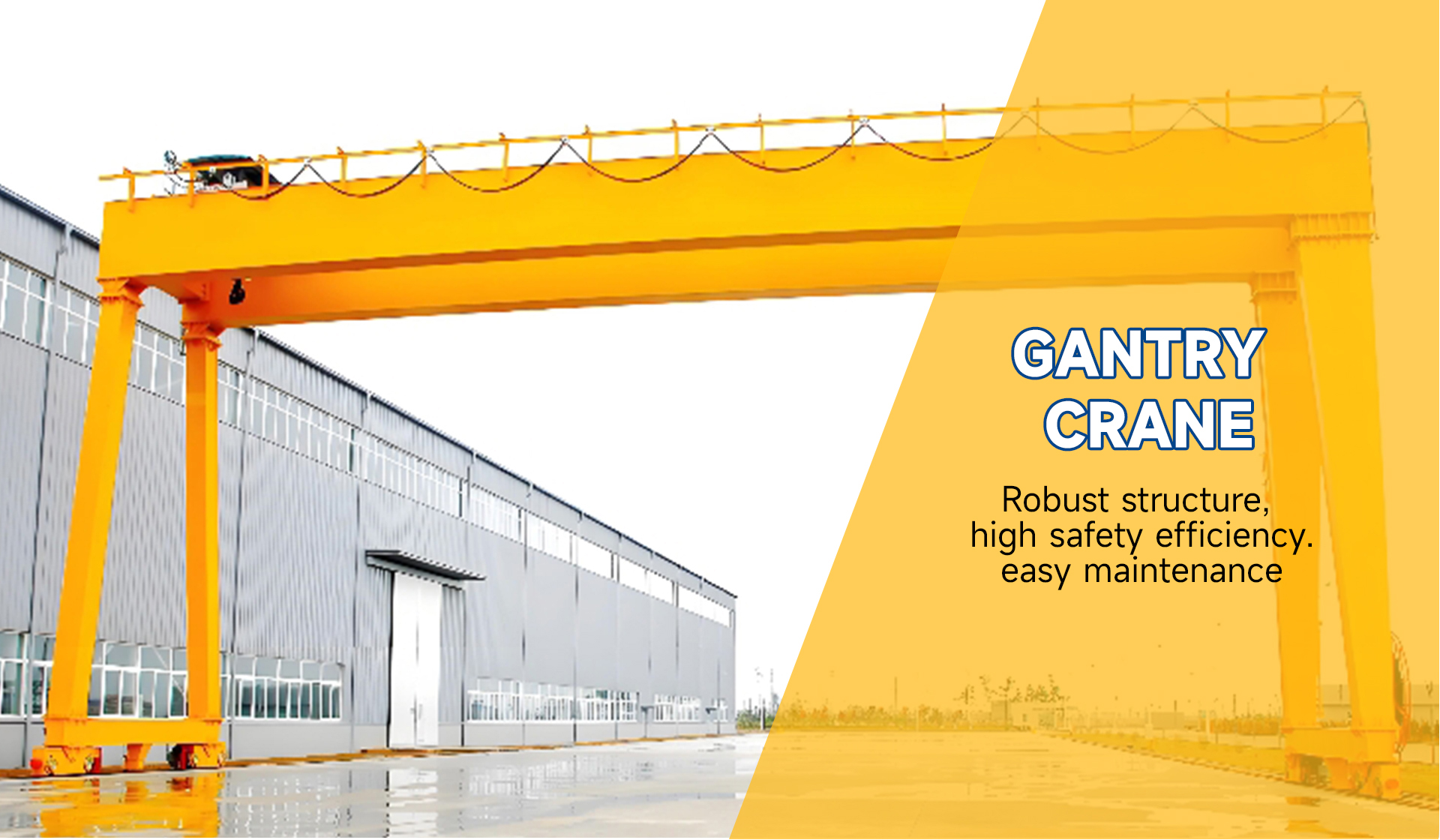
Gantry Crane Price Guide 2026
Gantry Crane Price Guide 2026: Cost by Tonnage, Type & Configuration Table of Contents Why a Gantry Crane
Hidden Costs of Importing a Gantry Crane
Hidden Costs of Importing a Gantry Crane: Shipping, Customs and Installation Guide Why Is a Gantry Crane Quote
Used vs New Gantry Crane: Total Cost of Ownership Explained
Used vs New Gantry Crane: Which One Has Lower Total Cost of Ownership (TCO)? Introduction When purchasing a
Gantry Crane Predictive Maintenance: How IoT Sensors Reduce Downtime
Gantry Crane Predictive Maintenance: How IoT Sensors Reduce Downtime Why Does Gantry Crane Downtime Cost So Much? Gantry
Contact Us Now
Have questions about our cranes or need help?
Reach out to our friendly team for expert support and guidance.
We are here to help you power your journey towards a greener future !
Address: Crane Industry Park, Xinxiang City Henan Provice
Hot Sales
Single girder overhead cranes
Double girder overhead cranes
Spider cranes