
Rubber Tyred vs Rail Mounted Gantry Crane: Which One Is Better for Container Yards?
Table of Contents
The Container Yard Challenge
What Is a Rubber‑Tyred Gantry Crane (RTG)?
What Is a Rail‑Mounted Gantry Crane (RMG)?
RTG vs RMG: Quick Comparison Table
Detailed Comparison by Key Factors
Decision Guide: Which One Fits Your Yard?
Can You Use Both?
Cost Considerations – Beyond the Purchase Price
Environmental Impact and Future Trends
Frequently Asked Questions (FAQ)
Need a Crane for Your Container Yard?
1. The Container Yard Challenge
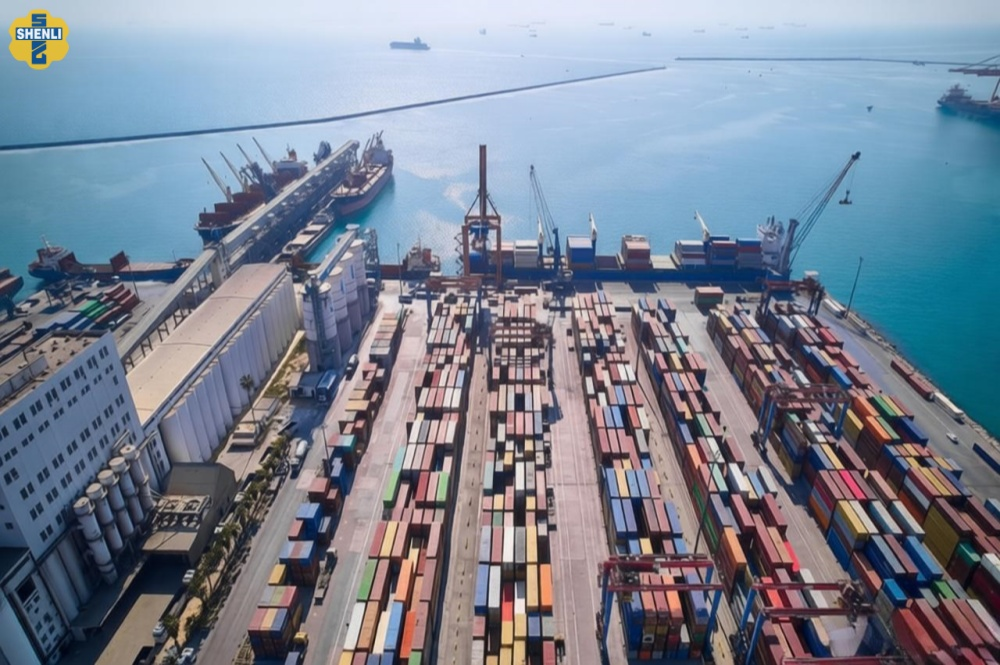
Running a container yard is about moving boxes fast, stacking them high, and keeping costs under control. The crane you choose directly affects your throughput, yard density, and daily operating expenses.
Two types of gantry cranes dominate container handling: rubber‑tyred gantry cranes (RTG) and rail‑mounted gantry cranes (RMG). Both do the same basic job – lift and stack containers – but they do it in very different ways.
New terminal operators and yard managers often struggle with this choice. Buy an RTG and you get flexibility. Buy an RMG and you get precision and lower long‑term costs. But there is no universal “better” – the right choice depends entirely on your yard layout, volume, and future plans.
This guide breaks down every important difference between RTG and RMG for container yards. By the end, you will know exactly which type suits your operation.
Let us start with a clear definition of each crane type.
2. What Is a Rubber Tyred Gantry Crane (RTG)?
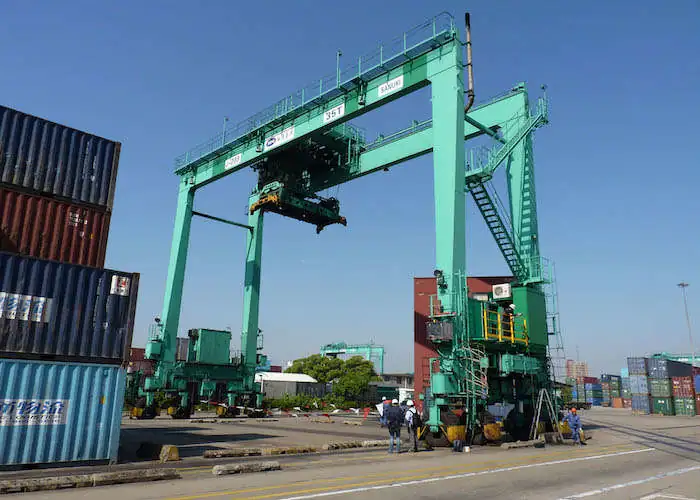
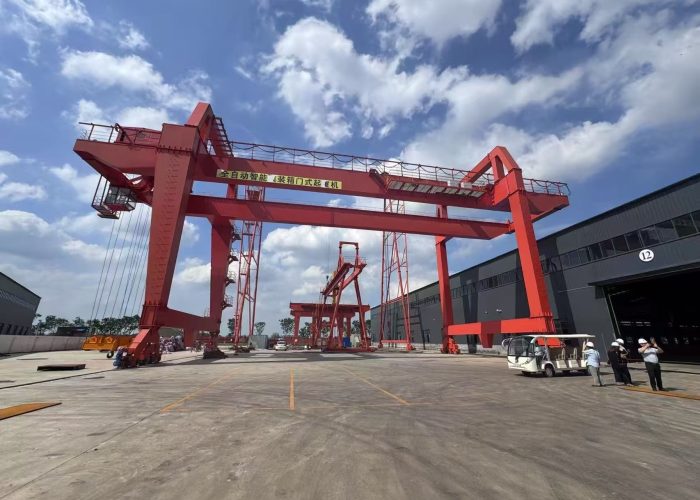
An RTG crane is a self‑propelled gantry crane that runs on large rubber tyres. It does not need fixed rails. The operator sits in a cabin high up, looking down at the containers below.
Key characteristics:
Mobility – Can move freely between yard blocks, turn, and even crab sideways.
Stacking height – Typically 4 to 6 containers high (some modern RTGs reach 8).
Span – Usually 5 to 7 containers wide (around 20–30 meters).
Power – Traditional RTGs run on diesel generators; newer models are electric or hybrid.
Where you see them: Container terminals, rail yards, empty container parks, and even some steel or precast yards. They are the most common crane type in medium‑sized and large container terminals worldwide.
Example: A port in Southeast Asia handles 500,000 TEU per year. Their yard layout changes every few years as the port expands. They chose RTGs because they can rearrange the stacking blocks without laying new rails.
RTG = flexibility and lower initial infrastructure cost, but higher fuel and tyre maintenance.
3. What Is a Rail Mounted Gantry Crane (RMG)?
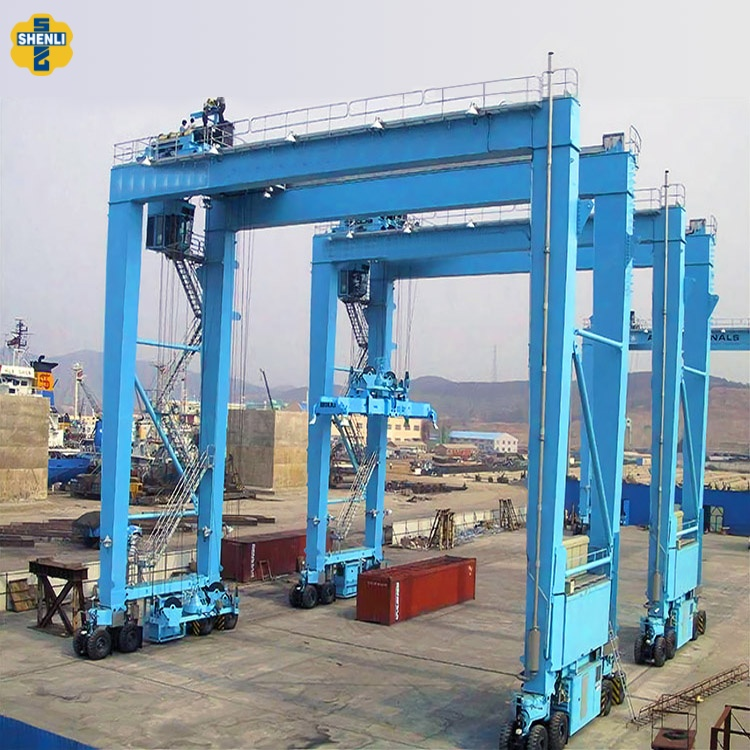
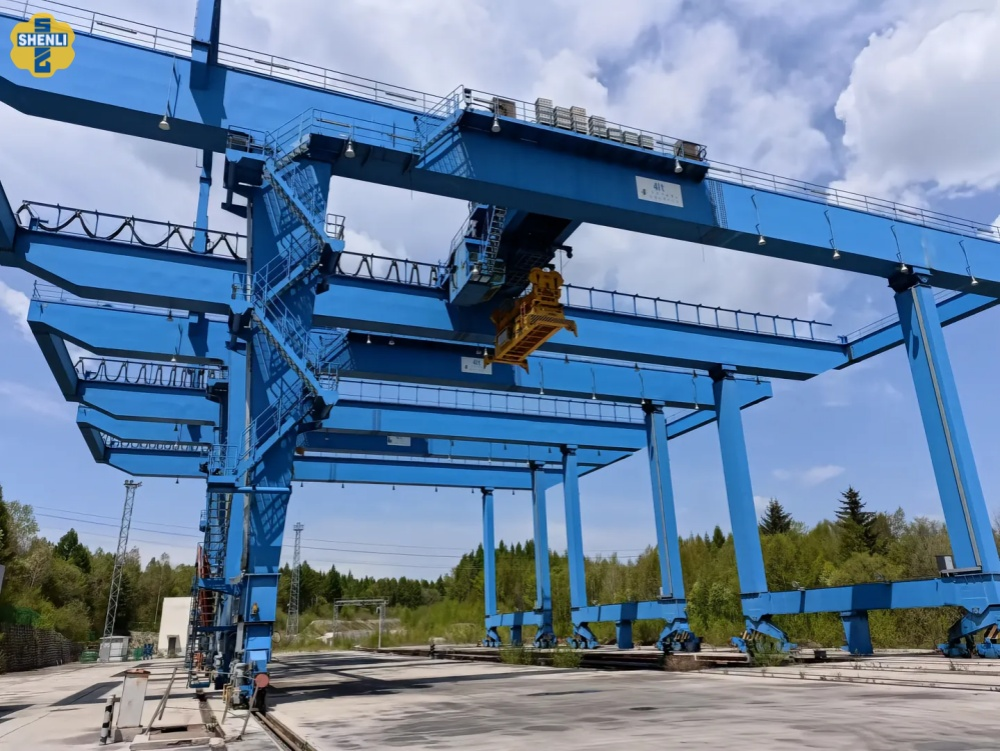
An RMG crane runs on fixed steel rails embedded in concrete. The rails guide the crane along a straight path. Most RMGs have a much wider span than RTGs, covering 8 to 12 container rows (30–50 meters).
Key characteristics:
Mobility – Only moves forward/backward on its rails. Cannot leave its dedicated block.
Stacking height – Up to 7 or 8 containers high (sometimes more in automated terminals).
Span – 25 to 50+ meters, covering many rows.
Power – Almost always electric, supplied via a cable reel or busbar.
Where you see them: Large, permanent container terminals, intermodal rail yards, and deep‑sea ports with fixed layouts. They are also the preferred choice for fully automated stacking operations.
Example: A high‑throughput terminal in Rotterdam processes millions of TEU annually. The yard layout is fixed for decades. They installed RMGs because stacking density and low operating cost matter more than flexibility.
RMG = precision, stacking density, and low operating cost, but requires permanent rail infrastructure.
4. RTG vs RMG: Quick Comparison Table
Use this table as your first‑level filter.
| Feature | Rubber‑Tyred Gantry Crane (RTG) | Rail‑Mounted Gantry Crane (RMG) |
|---|---|---|
| Mobility | Freely moves between blocks, can turn & crab | Only forward/backward on fixed rails |
| Track / rail requirement | None – works on compacted ground or asphalt | Permanent steel rails + concrete foundation |
| Span (container rows) | 5 – 7 rows (approx. 20–30 m) | 8 – 12+ rows (30–50+ m) |
| Stacking height | 4 – 6 high (some new units: 7–8) | 6 – 8 high (automated: up to 10) |
| Typical lifting capacity | 30 – 65 tons (most common: 40–45 tons) | 30 – 65 tons (can be higher for specialised) |
| Power source | Diesel generator (traditional), electric/hybrid (modern) | Electric via cable reel or busbar |
| Yard layout flexibility | High – can reconfigure blocks without civil works | Low – layout is fixed once rails are laid |
| Initial infrastructure cost | Low (just prepare the ground surface) | High (rails, foundation, drainage) |
| Operating cost (energy + tyres/rails) | Medium to high (fuel, tyres, engine maintenance) | Low (electricity is cheap, rails last decades) |
| Precision (container positioning) | Moderate – slight tyre flex and steering play | High – rigid rails, very accurate |
| Automation readiness | Possible but more complex (steering & alignment challenges) | Excellent – widely used in fully automated terminals |
| Emissions (traditional units) | High (diesel exhaust, CO₂, noise) | Low (zero tailpipe if electric) |
| Typical application | Expanding yards, multi‑block operations, low‑to‑medium density | High‑density fixed yards, automated stacking, rail‑connected terminals |
Now let us dive deeper into each factor that matters for your decision.
5. Detailed Comparison by Key Factors
5.1 Yard Layout & Future Expansion
RTG: Your yard layout is not permanent. You can change the number of blocks, adjust lane widths, or even move the entire operation to a new site. RTGs only need a compacted, level surface – no steel rails, no concrete beams. If your terminal is growing, or if you lease the land, RTG is usually the smarter choice.
RMG: Once you lay rails, you are committed. Changing the layout means digging up concrete, repositioning rails, and weeks of construction. However, for a fixed, mature terminal, RMG gives you the highest possible stacking density per hectare.
Ask yourself: Will my yard layout change in the next 5–10 years? If yes, lean towards RTG. If no, RMG becomes attractive.
5.2 Stacking Density & Land Use
Land is expensive. If your terminal is land‑constrained, you want to stack as many containers per square metre as possible.
RMG wins here. With spans covering 10 or more rows and stacking heights up to 8 containers, RMGs achieve much higher density. Some automated RMG terminals stack 10 high.
RTG typically covers 5–7 rows and stacks 4–6 high. You need more land for the same storage capacity.
Example: A 10‑hectare terminal using RTGs might store 25,000 TEU. The same terminal with RMGs could store 40,000+ TEU – a 60% increase without buying more land.
5.3 Mobility & Operational Flexibility
RTG is the clear winner here. An RTG can move between blocks, turn 90 degrees, and even drive around a congested area. If one block is quiet and another is overloaded, you drive the RTG over and help. You cannot do that with RMGs.
RMG is locked on its rails. It cannot leave its block. If you have a peak in one block, you cannot borrow capacity from another block without transferring the work to a different crane.
For terminals with uneven workload across blocks, RTG provides valuable flexibility.
5.4 Energy Consumption & Operating Cost
This is where many operators underestimate long‑term costs.
RTG (diesel): A typical RTG uses 25–40 litres of diesel per hour. At 1perlitre,thatis1perlitre,thatis200–320pershift.Addengineoil,filters,andoverhaulevery10,000hours.Tyrereplacementisalsosignificant–asetofRTGtyrescancost320pershift.Addengineoil,filters,andoverhaulevery10,000hours.Tyrereplacementisalsosignificant–asetofRTGtyrescancost30,000–$50,000 and lasts 5–7 years.
RTG (electric / hybrid): New generation RTGs with cable reel or busbar eliminate diesel. Operating cost drops to 20–30% of diesel. However, the power supply system (cable reel or busbar) adds upfront cost and reduces some mobility (the cable length limits travel distance).
RMG: Fully electric from day one. Electricity is cheap – about 10–10–20 per shift depending on local rates. No engine oil, no filters, no tyres. Rail wear is minimal. Over 10 years, the operating cost difference between a diesel RTG and an RMG can easily exceed $1 million per crane.
Example calculation (per crane, 4,000 operating hours/year, 10 years):
Diesel RTG: 4,000 h × 30 L/h × 1/L×10=∗∗1/L×10=∗∗1.2 million** (fuel only, plus maintenance)
RMG: 4,000 h × 40 kWh/h × 0.10/kWh×10=∗∗0.10/kWh×10=∗∗16,000** (electricity only)
The difference is staggering. Many terminals that choose diesel RTGs for flexibility later regret the fuel bill.
5.5 Maintenance & Reliability
RTG has more moving parts: steering axles, hydraulic systems, diesel engine, tyres (which can puncture or wear unevenly). Maintenance intervals are shorter. You need mechanic skills for both electrical and mechanical systems.
RMG is simpler: no steering, no tyres, no diesel engine. The main wear parts are wheels, brakes, and the power conductor. Maintenance is predictable and less frequent.
Verdict: RMG is lower maintenance and generally more reliable. RTG requires a larger maintenance crew and parts inventory.
5.6 Automation Potential
Automation is the future of container terminals.
RMG is the standard for automated stacking. Because RMGs run on fixed rails, the automation system always knows exactly where the crane is. Positioning is precise. Many large terminals (e.g., Rotterdam, Singapore, Los Angeles) use fully automated RMG blocks with no operators on the crane.
RTG can also be automated, but it is more challenging. The rubber tyres introduce slight positional uncertainty. Steering and alignment need continuous correction. Automated RTGs exist but are less common than automated RMGs.
If full automation is in your 5‑year plan, RMG is the safer bet.
5.7 Environmental Impact
Diesel RTGs emit CO₂, NOx, and particulate matter. Many ports now restrict diesel equipment or charge higher fees for vessels calling at terminals with high emissions.
Electric RTG (with cable reel or busbar) and RMG produce zero tailpipe emissions. If your terminal is in a region with strict environmental regulations (Europe, California, China coastal ports), electric RTG or RMG will be mandatory soon.
Battery RTG (using overnight charging) is another emerging option. It combines zero emissions with some mobility, but battery life and charging infrastructure add complexity.
6. Decision Guide: Which One Fits Your Yard?
Work through this flowchart in your head. Your answers will point to RTG or RMG.
Question 1 – Is your yard layout permanent for at least 10 years?
Yes → RMG becomes possible.
No (you expect to reconfigure, expand, or move) → RTG (or electric RTG).
Question 2 – Do you have a land constraint (can you buy more land)?
Land is expensive / unavailable → RMG (higher density).
Land is cheap and abundant → RTG (flexibility matters more).
Question 3 – What is your annual throughput?
Under 200,000 TEU → RTG often makes sense (lower upfront).
200,000 – 500,000 TEU → both possible; compare land cost vs fuel cost.
Over 500,000 TEU → RMG preferred (density + low operating cost).
Question 4 – Do you need to move cranes between blocks?
Yes, regularly → RTG.
No, each block can have its own dedicated crane → RMG (or RTG).
Question 5 – Is automation a 5‑year goal?
Yes, fully automated stacking → RMG.
Maybe, or only semi‑automation → electric RTG is also viable.
Question 6 – What is your electricity price and fuel price?
Low electricity, high diesel → RMG or electric RTG.
High electricity, low diesel → diesel RTG might be cheaper in the short term, but check environmental rules.
Quick decision matrix:
| Yard type | Recommended crane |
|---|---|
| Expanding terminal, leased land, moderate throughput | RTG (diesel or electric) |
| Mature terminal, fixed layout, high throughput | RMG |
| Land‑constrained, need maximum density | RMG |
| Multi‑block operation with uneven workload | RTG (to move cranes between blocks) |
| Fully automated container yard | RMG |
| Environmentally sensitive zone (port with emissions rules) | Electric RTG or RMG |
| Low initial budget, but can accept higher operating cost | Diesel RTG |
7. Can You Use Both?
Yes – many large terminals use a mix of RTG and RMG.
Common hybrid model:
Rail‑mounted gantry cranes (RMG) for the main, high‑density storage blocks.
Rubber‑tyred gantry cranes (RTG) for overflow areas, empty container parks, or “housekeeping” blocks where flexibility is needed.
For example, a terminal might have 50% of the yard as permanent blocks with RMGs, and 30% as flexible RTG‑served blocks, with the remaining 20% as a shared RTG zone.
There is no rule that says you must pick one type for the whole yard.
8. Cost Considerations – Beyond the Purchase Price
Many buyers focus on the crane price and forget the total cost of ownership. Here is a realistic 10‑year cost comparison for a mid‑sized terminal (6 cranes).
| Cost component | Diesel RTG (6 units) | Electric RTG (6 units) | RMG (6 units) |
|---|---|---|---|
| Crane purchase (each) | 700k–700k–1.2M | 800k–800k–1.4M (+cable reel) | 800k–800k–1.5M |
| Rails / foundation | $0 (just ground prep) | 0–0–50k (cable trench) | 1.5M–1.5M–3M (total) |
| Energy (10 years) | $7.2M (fuel) | $1.5M (electricity) | $1.2M (electricity) |
| Tyres / rail wear (10y) | $600k (tyres) | $600k (tyres) | $200k (rail wear) |
| Engine overhaul (10y) | $1.2M | $0 | $0 |
| Total 10‑year cost (approx) | 9M–9M–11M | 7M–7M–9M | 6M–6M–8M |
RMG has the highest upfront infrastructure cost but the lowest 10‑year total. Diesel RTG looks cheap initially but becomes expensive over time. Electric RTG is a middle ground – more flexible than RMG, lower operating cost than diesel.
9. Environmental Impact and Future Trends
Ports worldwide are adopting green terminal policies. The International Maritime Organisation (IMO) and local port authorities are pushing for carbon neutrality.
Diesel RTG faced restrictions in many European and Chinese ports already. Some ports charge higher vessel fees if the terminal uses diesel RTGs.
Electric RTG (with cable reel or busbar) is becoming the new standard for terminals that want flexibility without emissions. Some manufacturers offer “RTG with battery swapping” – zero emissions during operation and full mobility, but higher upfront cost.
RMG is naturally clean and efficient. For new terminals built today, RMG is often the baseline, with electric RTG used only for low‑density or expansion areas.
If your terminal operates in a region planning to introduce a carbon tax or require zero‑emission equipment by 2030, diesel RTG is a risky investment. Electric RTG or RMG will protect you from future regulations.
10. Need a Crane for Your Container Yard?
You have seen the trade‑offs between rubber‑tyred and rail‑mounted gantry cranes. Now it is time to apply that knowledge to your specific yard.
At SLKJCrane, we supply both RTG and RMG cranes for container terminals worldwide. We do not push one type – we help you choose based on your land, volume, budget, and environmental goals.
We provide:
Free consultation – tell us your yard size, throughput, and layout plans.
Electric RTG, diesel RTG, and RMG with custom spans and heights.
Automation‑ready control systems (remote, semi‑auto, full auto).
ASME, FEM, and ISO certified designs.
Worldwide shipping and installation guidance.
👉 Contact us today – share your container yard parameters (annual TEU, land area, power availability, future expansion plans). We will recommend the most cost‑effective crane type for your terminal.
Our Crane Product Range
SLKJcrane provides a wide range of lifting equipment solutions including:
– Single Girder Overhead Crane
– Double Girder Overhead Crane
– Gantry Crane
– Spider Crane
– Marine Crane
Our engineering team can configure safety devices and technical solutions according to project requirements.

Expert in Overhead Crane/Gantry Crane/Jib Crane/Crane Parts Solutions
Eileen
With 20+ years of experience in the Crane Overseas Export Industry, helped 10,000+ customers with their pre-sales questions and concerns, if you have any related needs, please feel free to contact me!
FAQ
No. The chassis is completely different. Converting an RTG to rail‑mounted would cost almost as much as buying a new RMG. Decide before you buy.
RMG typically stacks higher (7–8 containers vs 4–6 for standard RTG). Some specialised RTGs reach 7, but RMG is still the leader for high‑density stacking.
Almost, but not exactly. Electric RTGs with cable reels can travel the full length of the stack but are limited by cable length when moving between blocks. Battery RTGs offer full flexibility but cost more.
RTG span is typically 5–7 container rows (20–30 m). RMG span is 8–12 rows (30–50 m). RMG covers more ground per crane, which reduces the number of cranes needed.
For RMG, spare parts are mostly electrical – drives, brakes, wheels – and widely available. For diesel RTG, you also need engine parts (fuel injectors, filters, turbochargers) which can be manufacturer‑specific. Electric RTG parts availability is similar to RMG.
Yes. But RMG automation is more mature and used in many fully automated terminals. Automated RTG exists but requires more sensors and alignment systems.
Both are safe when properly maintained. RMG is on rails, so it cannot accidentally steer into equipment. RTG has more collision risk if operators are not careful, but modern RTGs have anti‑collision systems. RMG also has a lower risk of tyre blowout or uneven ground issues.
Used RTG is more common because many terminals upgrade to electric. Used RMG is rarer because RMG terminals tend to keep them for 20+ years. If buying used, get a full inspection: for RTG, check engine hours, tyre condition, chassis cracks; for RMG, check rail wear, wheel flanges, and conductor bar condition.
Latest Blog
Lorem ipsum dolor sit amet, consectetur adipiscing elit, sed do eiusmod tempor incididunt ut labore et dolore magna aliqua
Gantry Crane Price Guide 2026
Gantry Crane Price Guide 2026: Cost by Tonnage, Type & Configuration Table of Contents Why a Gantry Crane
Hidden Costs of Importing a Gantry Crane
Hidden Costs of Importing a Gantry Crane: Shipping, Customs and Installation Guide Why Is a Gantry Crane Quote
Used vs New Gantry Crane: Total Cost of Ownership Explained
Used vs New Gantry Crane: Which One Has Lower Total Cost of Ownership (TCO)? Introduction When purchasing a
Gantry Crane Predictive Maintenance: How IoT Sensors Reduce Downtime
Gantry Crane Predictive Maintenance: How IoT Sensors Reduce Downtime Why Does Gantry Crane Downtime Cost So Much? Gantry
Contact Us Now
Have questions about our cranes or need help?
Reach out to our friendly team for expert support and guidance.
We are here to help you power your journey towards a greener future !
Address: Crane Industry Park, Xinxiang City Henan Provice
Hot Sales
Single girder overhead cranes
Double girder overhead cranes
Spider cranes