
Cranes as the Backbone of Modern Steel Plants
How the Right Steel Plant Crane Solutions Drive Efficiency, Safety, and Profitability
The steel industry remains one of the most capital-intensive and process-driven sectors in modern manufacturing. Behind every ton of steel produced, there is a highly coordinated material handling system operating continuously under extreme conditions.
At the center of this system stands the crane — often overlooked, yet critical to steel plant safety, productivity, and long-term operating costs.
From raw material unloading at ports to finished steel handling in warehouses, cranes act as the “steel arms” that keep production flowing without interruption.
Based on real steel plant operating conditions, this article explains which types of cranes are used in steel plants, how they function in each workshop, and how selecting the right steel plant crane solution directly affects efficiency, downtime, and profitability.
👉 If you are planning a new steel plant, upgrading an existing workshop, or evaluating crane replacement options, Our engineer will help you make technically sound and commercially efficient decisions.
Raw Material Unloading at Ports and Steel Plant Terminals
Typical crane type: Portal Grab Crane
Raw material handling is the first and most time-sensitive step in steel production. Iron ore, coal, and bulk additives must be unloaded efficiently, continuously, and safely to avoid bottlenecks that impact the entire production chain.
Portal grab cranes are widely used in steel plant ports and raw material terminals due to their ability to handle high-volume bulk materials with stability and precision. Their smooth luffing movement, minimal load height fluctuation, and high operating efficiency make them ideal for continuous unloading operations.
Compared with other bulk handling equipment, portal grab cranes feature simpler structures, lower self-weight, and excellent cost-performance, making them a preferred solution for steel producers seeking reliable long-term operation.
Equipped with high-performance motors and intelligent grab control systems, these cranes reduce spillage and material loss while maintaining consistent throughput. Their strong wind resistance and proven safety design ensure stable operation even in harsh port environments.
👉 If your steel plant relies on uninterrupted raw material supply, selecting the right portal grab crane for steel plant ports is the foundation of stable production.
Typical models: MQ1030, MQ1625, MQ1635, MQ2530, MQ2535, MQ4030, MQ4035

Maintenance and Overhaul Operations in the Sintering Workshop
Typical crane type: Metallurgical Double Girder Overhead Crane
The sintering workshop is a critical preprocessing stage in steelmaking, where fine iron ore, fuel, and flux are converted into sinter that improves blast furnace permeability and energy efficiency.
Due to high temperature, heavy dust, and dense equipment layout, regular inspection, maintenance, and overhaul of sintering machines, ducts, fans, and dust-removal systems are unavoidable.
Metallurgical double girder overhead cranes are specifically designed for sintering workshop maintenance, offering high safety, precise positioning, heat resistance, and dust-proof protection. They allow safe dismantling, lifting, and reinstallation of key components during scheduled maintenance.
👉 If your sintering line operates continuously with limited shutdown windows, choosing a metallurgical overhead crane for sinter plant maintenance can significantly reduce unplanned downtime.
Typical specifications:
Lifting capacity: QDY 5–74 t
Span: 10.5–31.5 m
Duty class: A5–A7

Blast Furnace Front Area Maintenance in Ironmaking Plants
Typical crane type: Double Girder Overhead Crane
The ironmaking plant serves as the core conversion stage, where raw materials are transformed into molten iron. Blast furnace front equipment operates under continuous thermal stress and heavy mechanical loads, making reliability and maintenance efficiency essential.
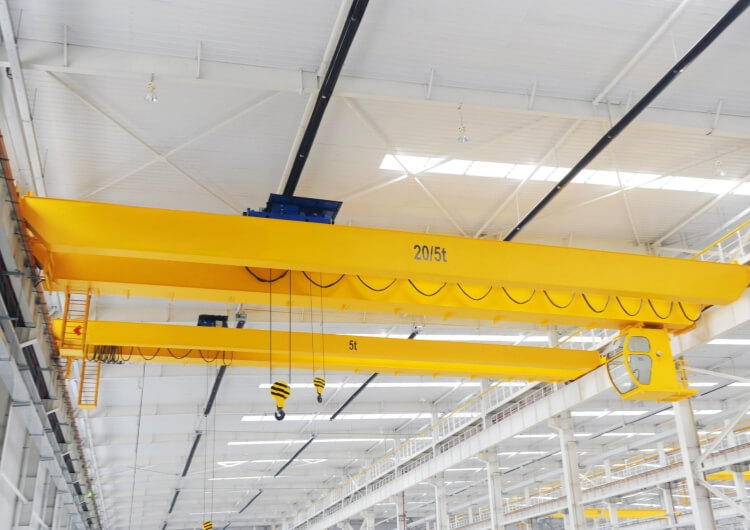
In this area, double girder overhead cranes are commonly used for blast furnace front equipment maintenance, including component replacement and repair operations. Their electrical systems, motors, and pulley assemblies are designed with enhanced heat resistance and dust protection.
Compared with metallurgical-specific cranes of the same capacity, these cranes offer a more economical solution while maintaining dependable performance and ease of maintenance.
👉 For steel plants seeking a balance between cost control and operational reliability, a double girder overhead crane for blast furnace maintenance is often the optimal choice.
Typical specifications:
Lifting capacity: QD 5–74 t
Span: 10.5–31.5 m
Duty class: A5–A7

Steelmaking Workshops: Charging and Ladle Handling Operations
Typical crane types: Ladle Crane & Charging Crane
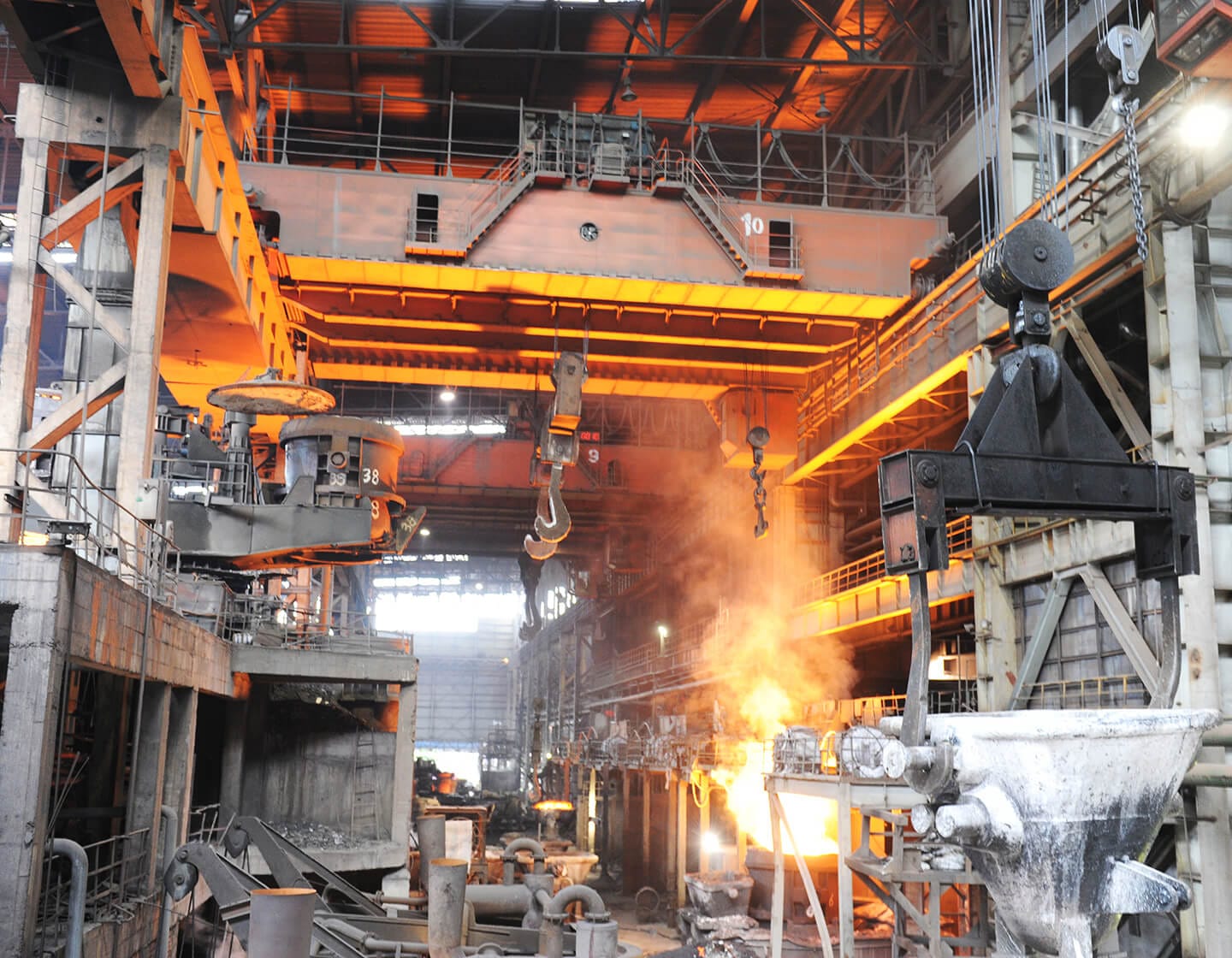
Steelmaking workshops represent the most demanding operating environment in a steel plant. Cranes here must function under extreme heat, heavy loads, dust, molten metal splashes, and continuous production cycles.
Metallurgical cranes used in steelmaking comply with JB/T 7688-2008 – Technical Specifications for Metallurgical Cranes. Their structures are engineered for high strength, minimal deformation, fatigue resistance, and long-term thermal stability.
Key safety and performance features include:
Heat insulation beneath main girders, cabins, and electrical rooms
Dual hoisting mechanisms for large-capacity ladle cranes
Dual braking systems with safety factors exceeding 1.5
VFD control for smooth, low-impact, energy-efficient operation
These cranes play a non-negotiable role in charging molten iron or scrap into furnaces and transferring ladles to continuous casting platforms.
👉 If your steelmaking line involves converters or EAFs, investing in a ladle crane and charging crane designed for steelmaking workshops is essential for both safety and productivity.
Typical specifications:
Ladle cranes: YZ 5–320 t, span 10.5–31.5 m, duty class A7–A8
Charging cranes: 20+20 t to 100+100 t, span 18–30 m, duty class A7–A8

Slab Yard Handling and Storage Operations
Typical crane type: Slab Clamp Crane
The slab yard acts as a critical buffer zone between steelmaking and rolling processes. Cranes here handle slabs at temperatures ranging from 800–1200°C, as well as cooled slabs requiring organized storage and precise dispatch.
Slab clamp cranes are designed for heavy-duty, continuous, and high-precision slab handling. They safely transfer slabs from continuous casting machines to insulation stacks or slow-cooling areas, reducing the risk of cracking caused by rapid temperature changes.
During storage and outbound operations, slabs are classified by material grade, size, and order requirements, then transported to reheating furnaces or preprocessing lines according to production schedules.
👉 For steel producers managing high-volume slab logistics, a slab clamp crane for steel slab yards ensures both safety and workflow efficiency.
Typical specifications:
Lifting capacity: 20–100 t
Span: 17–35 m
Duty class: A7–A8

Finished Steel Warehouses and Product Handling
Typical crane types: Electromagnetic Beam Crane & Hook Crane with C-Hook
Finished product warehouses represent the final stage before steel reaches the market. Cranes in this area must handle diverse product forms while protecting surface quality and maintaining high-frequency operation.
Common solutions include:
Electromagnetic beam overhead cranes for long steel products and bundled materials
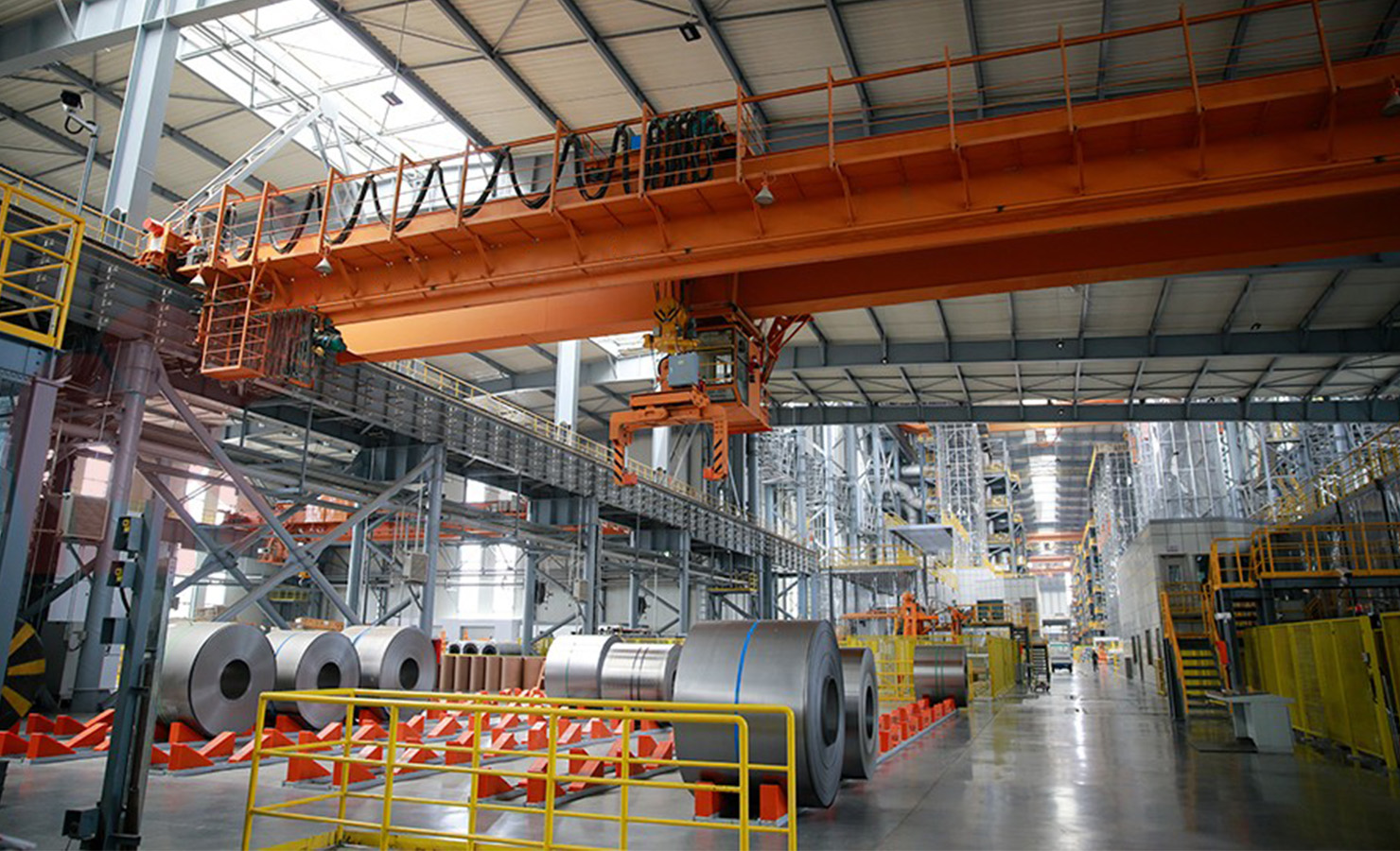
Hook overhead cranes with C-hooks for steel coil handling
These cranes support efficient loading, unloading, stacking, and dispatch, ensuring smooth logistics from production to shipment.
👉 If your warehouse handles coils, long products, or bundled steel, selecting the right finished steel warehouse crane solution directly impacts delivery efficiency and product quality.
Typical specifications:
Electromagnetic beam cranes: QCL (10+10) t to (20+20) t, span 19.5–31.5 m, duty class A6–A8
Hook cranes with C-hook: QD 10–100 t, span 10.5–31.5 m, duty class A6–A8

Conclusion: Choose the Right Steel Plant Crane to Upgrade Productivity and Profitability
Throughout the steel production process, cranes are far more than lifting tools. They are the backbone of safe operation, continuous production, and cost efficiency.
By replacing high-risk manual handling and minimizing downtime caused by equipment failure, well-matched steel plant crane solutions allow producers to move from basic operation to high-efficiency, high-profit steel manufacturing.
👉 If you are evaluating crane selection for a new steel plant or upgrading existing workshops, choosing cranes that truly match your operating conditions — not just capacity or price — is the key to long-term reliability and competitive advantage.

Expert in Overhead Crane/Gantry Crane/Jib Crane/Crane Parts Solutions
Eileen
With 20+ years of experience in the Crane Overseas Export Industry, helped 10,000+ customers with their pre-sales questions and concerns, if you have any related needs, please feel free to contact me!
FAQs About European vs Traditional Overhead Cranes
Steel plants use different cranes at each production stage. Common types include portal grab cranes for raw material unloading, metallurgical double girder overhead cranes for sintering and steelmaking workshops, ladle cranes and charging cranes for molten metal handling, slab clamp cranes for slab yards, and electromagnetic or C-hook cranes for finished steel warehouses.
Choosing the right crane depends on load capacity, temperature, duty class, and operating environment.
A metallurgical crane is specially designed for high-temperature, heavy-duty, and continuous operation environments such as steelmaking workshops.
Compared with standard overhead cranes, metallurgical cranes feature enhanced heat insulation, higher safety factors, dual braking systems, dual hoisting mechanisms (for ladle cranes), and comply with standards such as JB/T 7688-2008.
Crane selection should be based on actual operating conditions rather than capacity alone. Key factors include lifting load, duty class (A5–A8), ambient temperature, dust level, handling frequency, safety requirements, and workshop layout.
Working with an experienced steel plant crane manufacturer helps ensure the crane matches both production needs and long-term reliability.
Steel plants require cranes to operate continuously under heavy loads. Duty class determines fatigue strength, structural design, and service life.
Using a crane with insufficient duty class can lead to premature failure, safety risks, and costly downtime. Most steel plant cranes require A6–A8 duty class depending on the application.
Yes. Steel plant cranes are typically customized based on workshop dimensions, production flow, ladle size, slab dimensions, and local standards.
Customization may include heat-resistant materials, special lifting attachments, automation interfaces, and safety protection systems.
👉 If you are planning a new steel plant or upgrading existing crane systems, providing layout drawings and operating parameters allows manufacturers to design a truly suitable solution.
Latest Blog
Lorem ipsum dolor sit amet, consectetur adipiscing elit, sed do eiusmod tempor incididunt ut labore et dolore magna aliqua
How to Select the Right Overhead Crane for Steel Mills
How to Select the Right Overhead Crane for Steel Mills: A Complete Selection Guide In the high-stakes environment

Overhead Crane Safety Devices
Overhead Crane Safety Devices: 7 Essential Protection Systems for Overhead and Gantry Cranes Introduction Overhead cranes and gantry
Cranes as the Backbone of Modern Steel Plants
Cranes as the Backbone of Modern Steel Plants How the Right Steel Plant Crane Solutions Drive Efficiency, Safety,
Where Spider Cranes Really Shine: 7 Typical Applications & Real Project Scenarios
Where Spider Cranes Really Shine: 7 Typical Applications & Real Project Scenarios When people ask me about spider
Contact Us Now
Have questions about our cranes or need help?
Reach out to our friendly team for expert support and guidance.
We are here to help you power your journey towards a greener future !
Address: Crane Industry Park, Xinxiang City Henan Provice
Hot Sales
Single girder overhead cranes
Double girder overhead cranes
Spider cranes